Friday, February 24, 2006

Are we there yet?

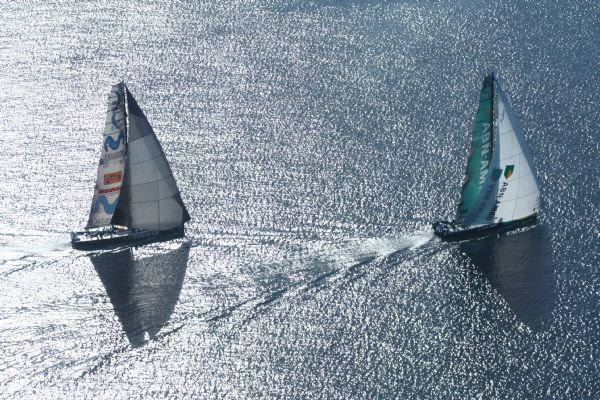
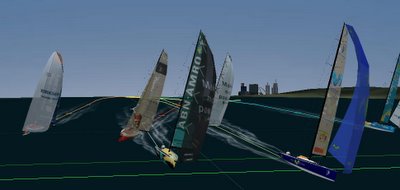
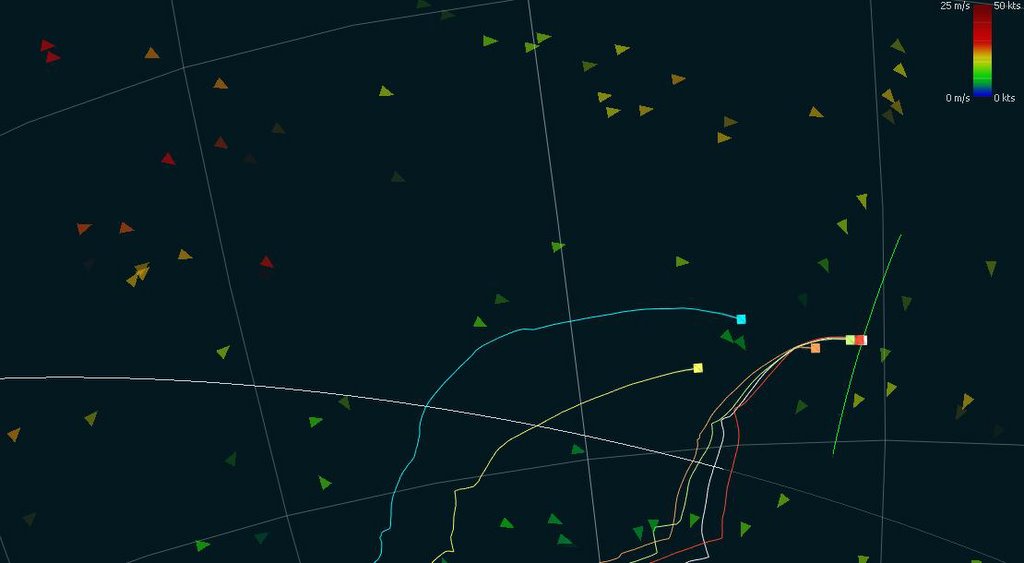
Yes, the back seat drivers stuck in the middle of the Pacific can relax. The boats of the Volvo Ocean race have finally reached the first ice gate on the long leg from Wellington to Rio. Now they can bear away and head for the next one, same latitude just further east.

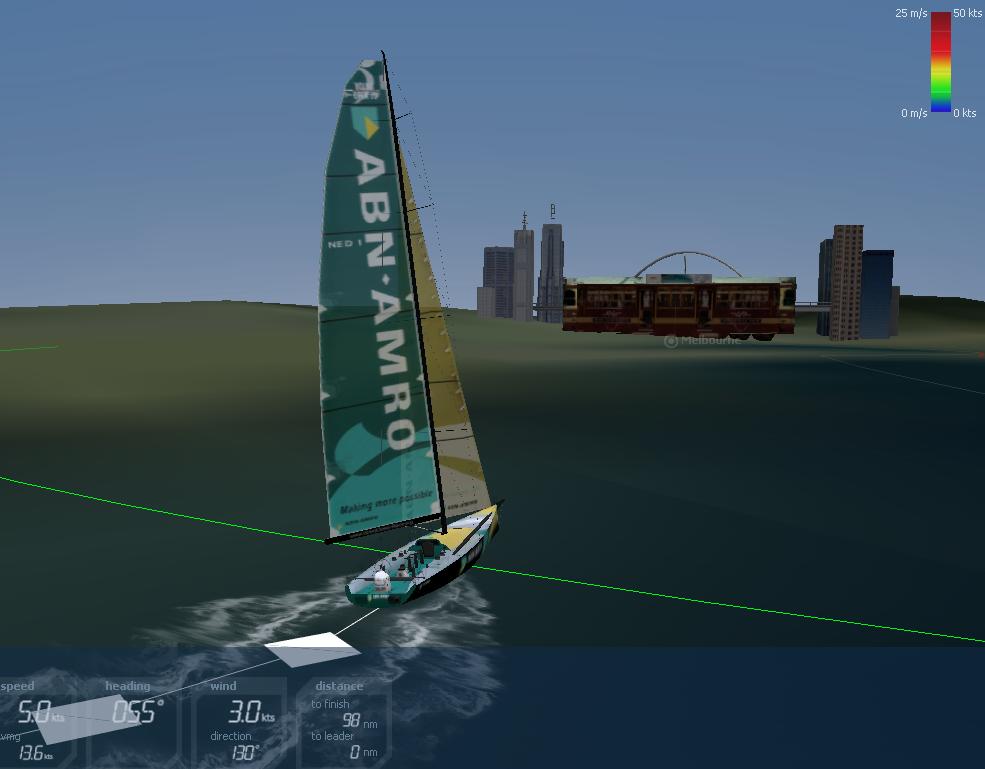
But as the figure above from Virtual Spectator, behind them are the strong winds which for once have been forecast well in advance. So the fleet is battening down the hatches and checking the rigging for what is to come.

Already ABN AMRO TWO at the tail end has experienced winds up to 30 knots and thats just the start of what could be a rough 24 hours. It can't be much compensation to see that their sister ship's radical tactical move south has put them in the lead, over 200 miles ahead.

However it must be somewhat of a confort to Moose and the rest of ABN AMRO ONE that their gamble paid off. Maybe the weather didn't pan out just as expected, but it was enough - and they missed the worst of the wind hole.

Though as an email from the kids navigator Simon Fisher put it, there are still 3,000 miles to go.

Thursday, February 23, 2006

Slowly does it

Its a hard slog for the boats on Leg 4 of the Volvo Ocean race as they make their way to the ice gate. The race organisers have located it in the part of the southern Pacific where not only is there little wind but erratic and unpredictable wind at that.

To make it even more fun there's a storm brewing about to roar in with 50 knot winds and 30 foot waves. So they really really want to get through that gate so they can head off to Cape Horn. But Moose and the boys on Black Betty are currently heading west of north. What is pretty gutting is they could easily make a nice easterly course from where they are.

They're at 50S but there's just 5 knots of wind. If that keeps up, with 4 degrees of latitude to go it might take them a day to get to the gate under current conditions.

I'm sure they can't get out of there quickly enough.

Wednesday, February 22, 2006

Navigator's Nightmares

So ABN AMRO ONE goes from first to last to first. Where will it go next? That depends upon the weather. But where will the wind blow?

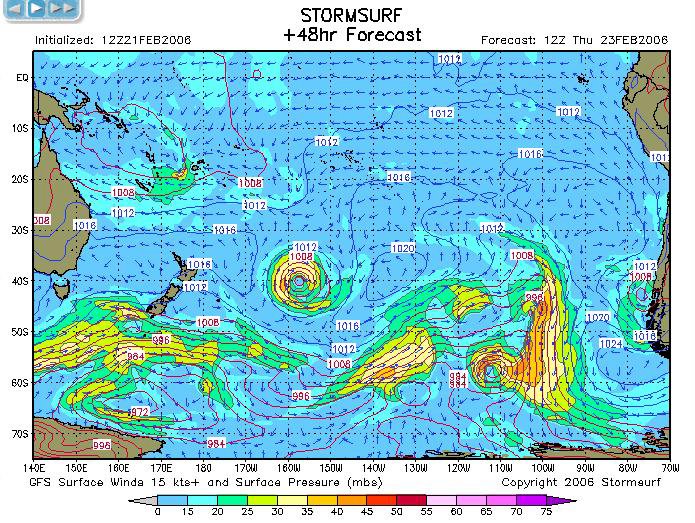
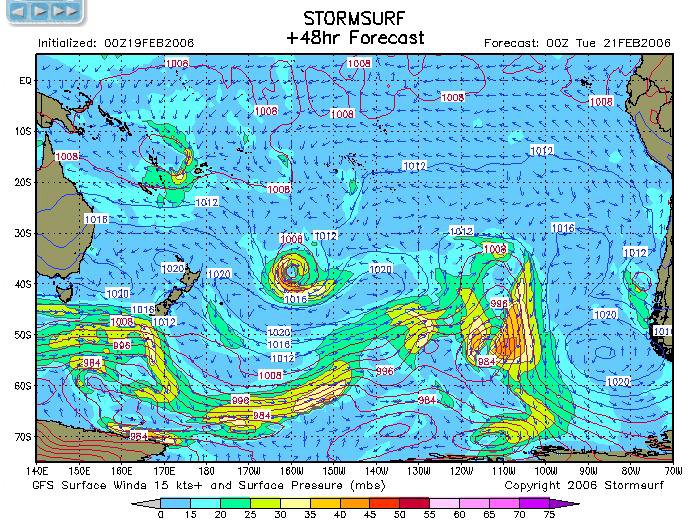
The forecasts have been the stuff that makes navigators wake up screaming - if they get any sleep, searching GRIB files for clues about where to head next. Take the two predictions below, both from www.stormsurf.com and both for the same time, 12Z on Thursday 23rd February.

The first was from yesterday:
The second is today:
The boats are around 51 - 53S, 152 - 157W, where the forecast is so different. It's all changed - the low meant to come up from the south and the one predict to come down from the north have both fizzled out, leaving fluky weather, winds that could come from any direction. Getting the routing right can be a matter of pot-luck, or some inspired reading of the isobars.

Further ahead there are the lows behind with awesome 40 foot waves. But the storm should weaken mid Pacific by which point the fleet should be safely further east.

As to what to do now? Just get to that ice gate before the wind runs out and you grind to a halt like ABN AMRO TWO and Brazil.

Tuesday, February 21, 2006

Interesting. Impressive.

I was looking at the forecasts last night and was unable to feel sufficiently confident to give a view on the proper routing. But one thing was clear - the uncertainty would lead to hard choices for the boats currently fighting out leg 4 of the Volvo Ocean Race. And the morning's position table certainly was interesting, with ABN ONE dropping from first to last.

A quick look on Virtual Spectator and it was clear the navigators had a rapid change of heart, with a dash south as in the figure above. What was really impressive is how Black Betty showed her speed and caught up Pirates. That must give Moose and the guys a lot of confidence to re-write their tactics on the fly and trust the boat to see them through.

As to where now, thats even more interesting. There are a host of lows coming in from all directions. One from the tropics, one from NZ and one from the deep south, as can be seen in the forecast from www.stormsurf.com for 2 days out:

The question is - where will the fleet be? Ok, so I have no routing software just half an envelope, and old biro and a calculator, but here goes. As in the previous post suggested, the VO70s can do about 7 - 8 degrees of latitude in 24 hours. This was ok when they were heading south, but now they are mostly heading east, so at 50S that's a factor of 0.642 or about 11 - 12 degrees of longitude per day.

At the moment they are at around 165W so this time tomorrow it will about 154W and the day after at 143W. It might be a bit less to include a bit of N/S movement eg to get to the ice gate between 148W and 143W at 48S.

So if you look at the figure above you can see the most important low is the one coming up from the Antartic, hence the dash for more wind in the south.

After that, well - again- its interesting......


Graphics from Virtual Spectator and www.stormsurf.com

Monday, February 20, 2006

The longest day

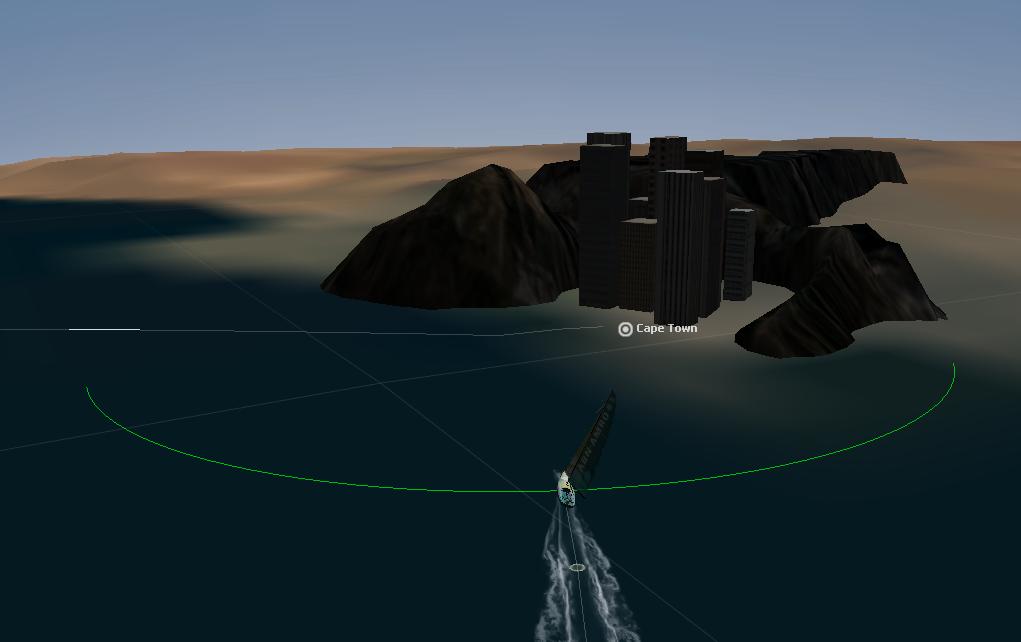
I've finally got round to switching on one of Virtual Spectators more esoteric overlays - the international date line. If you felt today was a long day, that's nothing compared to how long Monday was for the crew of the Volvo Ocean race, as they crossed from the eastern to western hemispheres.

But at least all the fleet seems to have avoided the breakages that plagued so many of the past legs, even though the result of ABN AMRO ONE course curving south then south east as it smoothes into the lead seems all too familiar.

Behind there's been some good competitive sailing, with Ericsson and Pirates battling out for third, and movistar showing how even a 2 hour handicap at the start won't stop them catching Brasil. Indeed if it was just Farr designs there wouldn't be this talk about which boats were disappointing. But the Juan Kouyoumdjian designed ABN twins do seem to have an extra gear, especially in the nice reaching conditions.

It won't last. The forecasts are getting uncertain, depending not on the lows barrelling around the southern ocean but one dropping in from the tropics. There might even be a bit of light winds to slow the leaders down.

This could get interesting.....


Picture from Virtual Spectator

Sunday, February 19, 2006

The Road to Rio

Good luck and safe sailing for all boats and crew currently heading out of Wellington taking the long road to Rio across the southern Pacific. The longest leg of the Volvo Ocean race has started with all boats pointing their noses south to south-east.

While checking out the final crew list (which can be found here) I noticed something interesting - half the navigators are Brits. Ok, its only a small sample of six now Brunel has decided to sit out the legs between Melbourne and New York. But is it a fluke or an indicator? Does Britain's wider view of the world (say compared to Americans) give a greater feel for geography? Does the famous British weather and Brit's interest in the weather develop an intuitive feel for highs, lows and fronts?

Anyhow, being another Brit with an interest in navigation, a quick look ahead, graphics from www.stormsurfing.com. The wind and pressure for the next 24 hours and 48 can be seen below. As a rough estimate if the boats do 420 - 480 miles in 24 hours they will cover about 7 - 8 degrees of latitude.

A big low can be seen to the north east (at around 35S, 160W) squeezing a high below it. There's currently good wind at 50S, 170W but by the time they get there it will probably fade out, leaving lighter winds. Thats not good news for Moose and Black Betty, but maybe a ray of light for Neil & co on Ericsson.

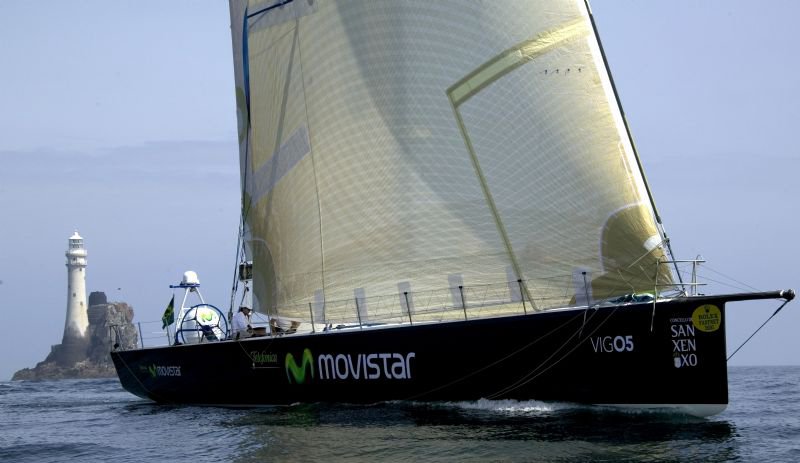
By the way, the pretty picture at the top comes from http://team.abnamro.com/ and shows the end of leg 3.

Saturday, February 18, 2006

Leg 4 Preview

Tomorrow sees the start of leg 4 of the Volvo Ocean race as the fleet heads out across the wide wilderness of the southern Pacific. From Wellington they will have to cross 6,700 miles of rolling seas before seeing the welcoming sight of Sugar Loaf Mountain. And by now the skippers and nagivators will have an idea of whats ahead, having had time to crunch the numbers, running scenarios and working out strategies for the days ahead.

The direct great circle path to Cape Horn drops down to 65S so ice gates have been placed at 48S to keep the high tech speedsters safely north. At the start there's a high to the east (see figure below) which will drive the boats south from the start, seeking the stronger westerlies at 50S.

A key question is how much pure southerly and how much a bit of easterly, but that will probably depend each boat's sweet spots and best points of sail. After that..... lets see what the weather brings.


Graphic from www.metvuw.com

Thursday, February 16, 2006

Half a boat length and half finished

So its congratulations to movistar. Not just for clinching a win on the 3rd offshore leg of the Volvo Ocean race, but also giving us spectators some variety in the leg position board. For once its not ABN AMRO ONE heading the fleet but having to make do with second place. But what a battle it must have been over those last few miles, with only 9 seconds and half a boat length dividing the two.

Then the improving Brasil and Pirates, followed by the ABN boys on TWO, no doubt eager to get cracking on fixing their main.

But not followed by Ericsson, or at least not officially. For Neil McDonald's boat has crossed the line but not finished, having suspended racing. They are rather cleverly taking advantage of the rules to do some urgent boat fixes without incuring any time penalties. Unlike movistar who's urgent keel work will mean they'll suffer a two hour penalty.

Its interesting to see that Ericsson are not blaming their poor performance on this leg on anything breaking. We've all had those moments when you fall out of the grove and nothing seems to work. But is the boat "one of the fastest in fleet" as Yachting World said? The evidence from the past few days is not that encouraging.

Meanwhile its congratulations to Dee Caffari for passing half way and is now passed New Zealand heading west towards Australia. As the Volvo crews downs some cold ones in the bars of Wellington she has for once a bit of nice reaching weather to look forward to.

Picture from Virtual Spectator

Wednesday, February 15, 2006

Front to back

Its not much fun being Neil McDonald at the moment. Leg 3 of the Volvo Ocean race has been a near rumb line drag race, with the various teams showing what their boats are made of. At the front yet again was ABN AMRO ONE, the black boat showing her legs whenever the wind picked up. At the back was yet again Ericsson, overtaken even by ABN AMRO TWO with its split main.

The emails on the Volvo site describe the feelings of the crew and the mental energy needed to keep them going when they see yet again boats fly past whatever sails they set, leaving them stuck at the back.

This has happened enough for worries to mount that there is nothing they can do. Captain JP's three rules of how to win an ocean race (see below) only applies once you start. There's also a zero-th: get a competitive boat.

Last time round the world Neil crewed and then skippered Assa Abloy which must have won their hearts with her ability to kick her heels and fly to the front. It seems they have no such luck this time, no prospect of being "first after Australia".

When competing in a race that takes all, body and soul for months, requiring endless committment, to make that extra effort when drained to ones core, this is a bitter cup to drain.

Meanwhile at the front it's a different story, with two of the boats that have been longest in the water fighting a glorious tacking battle all the way to Wellington. This will be a leg climax to relish, the fat boat ABN AMRO ONE that likes strong winds having to fight movistar inch by inch in winds light and getting lighter.

Watch this space!

Captain JP's three rules for ocean racers:
(1) Don't break anything critical
(2) Get the weather routing right
(3) Sail fast


Pictures from Virtual Spectator

Sunday, February 12, 2006

Off again!

No, Captain JP isn't off to the slopes again (alas). It's the start of the third offshore leg of the Volvo Ocean race. Can it match leg 2 for thrills, breakages and world speed records?

Certainly the slog from Cape Town to Melbourne produced more than its fair share of drama. All of the Farr boats suffered some sort of damage and questions about the new Volvo design ever more pertinent.

But its noticable that the two ABN boats mostly survived intact, which many are putting down to the time on the water to shake down the problems (though it didn't help movistar so much). With Captain JP's engineer hat on, its always the case that new technology will produce problems - thats why you always have a test phase.

It was interesting to hear a Farr designer admit on the Volvo TV show that they didn't know much about hydraulics. But its through exercises such as this they (and the industry) can learn. For those that know about hydraulics don't know about the stresses on a boat powering into a head-sea in 40 knots of wind.

So is it "madness" to quote Yachting World? The success or failure of the new design will depend upon two things - the sponsors and the sailors. There's no doubt this Volvo has been making headlines if only for the wrong reasons. And there's no doubt that when these boats go, they go like rockets. Just watching the in-port race in Melbourne is enough to get the adrenaline going.

Could the Volvo go back to old technology such as static keels as used by the Open 60s? Would such designs have any chance of beating the 24 hour record set by ABN AMRO 2? Would that matter to those who fund this race?

Its interesting to see what has happened to Brunel - carted off to join the others only for the transatlantic leg. And why? For thats the leg with the best chance of beating that world record. For thats the sort of news that sponsors like to be associated with.

Eventually the bugs will be ironed out. Its gutting for the likes of Ericsson who had such a good start, but all engineering takes time to get right. Look at the Clipper fleet: new boats, all known technology, but they too have had keel problems and the race has had to be suspended and crew flown home.

You can't even say take the safe option and a Challenge boat 72 foot of steel like Dee Caffari battling her way across the south pacific about to meet the Volvo's going the other way. For those too had problems in the early days with their masts (remember that?) and Dee for all her heroics of weeks of tacking to windward is never going to get a 24 hours speed record.

The Volvo 70 certainly has its vocal supporters, led by Mike "Moose" Sanderson. Well, he has some reason for having warm feelings about Black Betty as ABN AMRO ONE is affectionatly called, as he has won yet another couple of points by coming first yet again in the Melbourne in-port race.

So its congratulations to Moose - again!

He must be getting used to people saying that. And not just for his habit of winning races. It appears that Emma Richards has a good excuse for not (yet) getting in touch with Captain JP about that sail in the solent. For she and Mike are now engaged.

All together now, ahh.....

But Mike will have to sail really fast to be in Wellington in time for Valentine's day.


Picture from Virtual Spectator
Saturday, January 21, 2006

Off skiing

I'd hoped to be able to post the news of who won leg 2 of the Volvo Ocean race, but there are still 25 miles to go on a leg that has taken longer than expected. But unless there is a Mike Golding "my keels just fallen off" sort of moment, it looks like Mike Sanderson and crew on ABN AMRO ONE, nick named Black Betty, will be picking up the full 14 points.

So congratulations to them and see you in a week, as Captain JP is off skiing.

Friday, January 20, 2006

Its not over till its over


Earlier in leg 2 of the Volvo Ocean Race, Mike Sanderson's Black Betty was over 350 miles ahead of the rest of the fleet, only to see their lead evaporate at the windless centre of a high.

With under a hundred miles to the finish line in Port Phillip Bay he must be gnawing his fingernails to the bone wondering if the juniors on ABN AMRO TWO are to catch him again.

Now what matters is not the grib files and routing software, but knowledge and experience of sea breaze and tidal flows.

And who wants that first beer the most.

All in all, a bit like this year's Fastnet then!


Picture from Virtual Spectator

Wednesday, January 18, 2006

Four keels and a dismasting

Yet another casualty on the second leg of the Volvo Ocean Race from Cape Town to Melbourne across the southern oceans. On this leg there has already been not one, not two, not three, but four of the seven boats suffering keel problem. Now Brazil has broken its mast in three places and is limping towards Australia under jury rig. With over 2,000 miles to go and the clock ticking till the next in-port race on the 4th February it looks they have no choice but to retire and head to Albany after picking up the Eclipse Island points.

This will more ammunition to the critics of the new Volvo 70. But no one will be able to say it's not been an eventful race, full of drama.

On the one hand the design has shown that monohulls can compete with multis with the 24 hour speed record raised to an amazing 563 miles. On the other a new design where only two boats have not (yet) suffered serious keel or mast failure is at the very least on a steep learning curve.

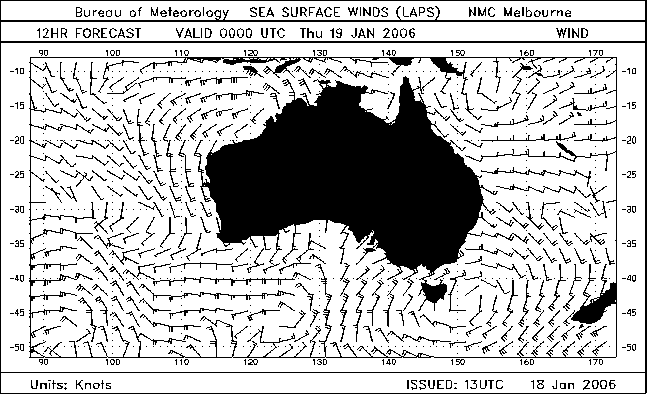
Meanwhile Pirates having tested their reparis by trying out most sail angles have settled down chasing movistar and the ABN twins towards Melbourne. With under 600 miles between Black Betty and Melbourne it seems unfair that there's a head wind between them and those longed for cold ones. As the forecast below in the figure shows, they can expect 20 knots from the north east. And they are heading, yes thats right, north east.

Pictures from Australian Bureau of Meteorology

Tuesday, January 17, 2006

Counting down the tacks

With ABN AMRO ONE less than a thousand miles from the finish line of Leg 2 of the Volvo Ocean Race, can they count down the tacks as they count down the miles?


As one heads east in the picture above, the wind becomes increasingly southerly - so might even a single tack finish be possible?

Alas over the next few days the wind is backing increasingly northerly as can be seen in the figure below of Thursday's forecast. So there's more work to do before the sweet sound of the finishing gun.


Pictures from Virtual Spectator and Australian Bureau of Meteorology

Pirates ahoy!

The Pirates have launched back to sea but are they ready for battle? Their course has been erratic over the last few hours, tacking from side to side as a true drunken sailor. Is their keel really back to 100%? They have the time in hand with 500 miles over ING - so could another land raid be in order?

Picture from Virtual Spectator

Sunday, January 15, 2006

Its not over till the fat lady sings

Just as the Moose and the grown ups on Black Betty seemed to have Leg 2 all wrapped up the boys on ABN AMRO TWO gave them a shock by nosing in front.


It didn't last - as of this posting ABN AMRO ONE is yet again at the top of the leader's board. But this is feeling like a mid-leg re-start for the three leading boats currently compressed into under 30 miles.

Mike and co have slightly stronger wind but also slightly less advantageous wind angle for the final 400 miles to Eclipse Island. Then, as the figure below shows, a beat to windward to Melbourne.

By now thoughts will have turned to showers, clean clothes, beers, proper food, more beers, and beds. But with the competition so intense none of them can relax. And an ever nagging worry must be - will any other boats suffer major damage?

For in the last few days both movistar and Pirates have had their own keel problems which the ABN duo have so noticably avoided. The Volvo 70's relability and more importantly suitability, is a topic that has stirred much controversy - so more on this later.


Pictures from Virtual Spectator and NOAA

Saturday, January 14, 2006

Slowing down, stacking up

As the Volvo boats approach Australia they are slowing, compressing what remains of the fleet close together, with Two now under a hundred miles from One.


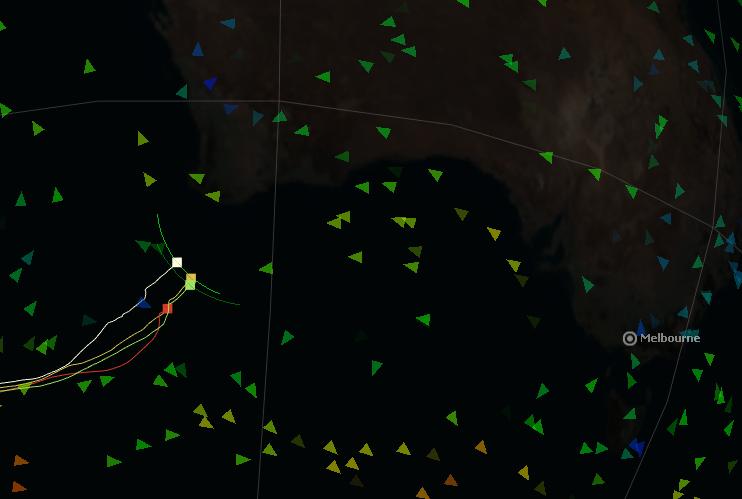
For Mike Sanderson is heading straight into the centre of a high and the reported wind speed at ABN AMRO ONE is a mere 5 knots.

But he has little choice. There seems no way round the band of slow wind as can be seen in the figure below so he is forced on the direct route however frustrating that will be (for reference his approximate location is 40S 110E).


So there's hope for the chasing pack. But after they round Eclipse Island it looks like they'll be back in bumpy upwind sailing. Lets hope nothing more breaks.

And talking of tough upwind sailing, its good to hear that Dee Caffari has come through the gale in the south pacific off Cape Horn and is now sailing west under blue skies with winds in the 20 - 30 knot range.

Pictures from Virtual Spectator and NOAA

Wednesday, January 11, 2006

Two fast

Congratulations to the lads on ABN AMRO TWO who today broke the 24 hour speed record again and again to finally reach an amazing 560 miles!

It proves what the amazing boats of the Volvo 70s are capable of achieving. All the bells and whistles from carbon hulls to canting keels are stretching what a racing monohull can do. But there has been criticism of the new designs as well.

One frequently heard complaint is that they are too easy to break. But new designs are oft tested to destruction on their first real trials. And there are no end of Open 60s that have broken in the anvil of the Bay of Biscay. Mike Sanderson for one has been emailing his support for Black Betty and her cousins.

A more serious complaint is the complexity means high cost which means small fleets. Which raises the question, what makes an exciting Volvo? Is it the latest technology and record breaking speeds or is following a pack of competitors?

What do you think?

Tuesday, January 10, 2006

More points for ONE

First blood to the Moose, as ABN AMRO ONE earns 3.5 points for leading at the first mark. It's been a good leg so far for Black Betty, as Mike and the team have shown they have what it takes to win this leg and, as many must be whispering, the Volvo.

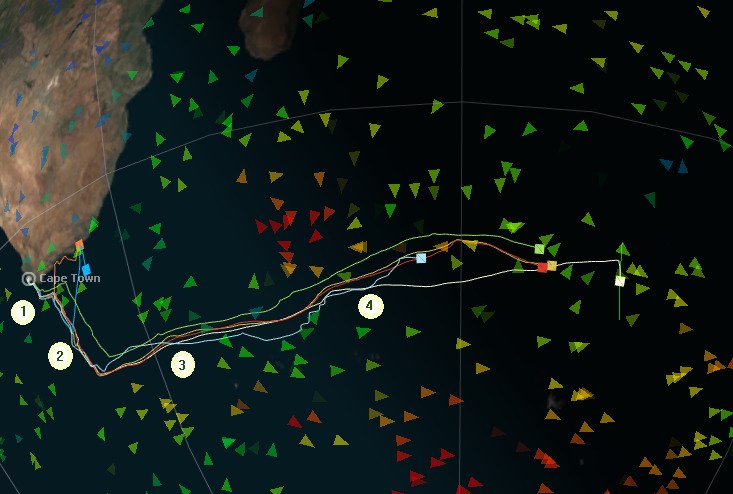
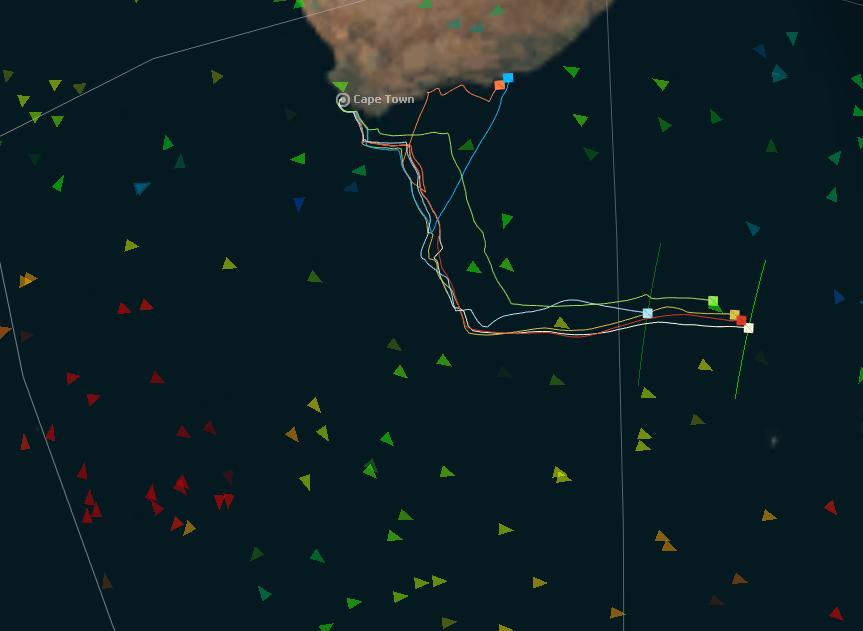
The figure above shows four key stages where ABN AMRO ONE 's actions have helped land those valuable points:
1) Getting through the first hours without major breakages (unlike Ericsson)
2) Heading straight south for the stonger winds (unlike movistar)
3) Showing its edge in boat speed to get her nose ahead (of Pirates)
4) And the lucky bonus of the front to jump 300 miles ahead (of everyone)

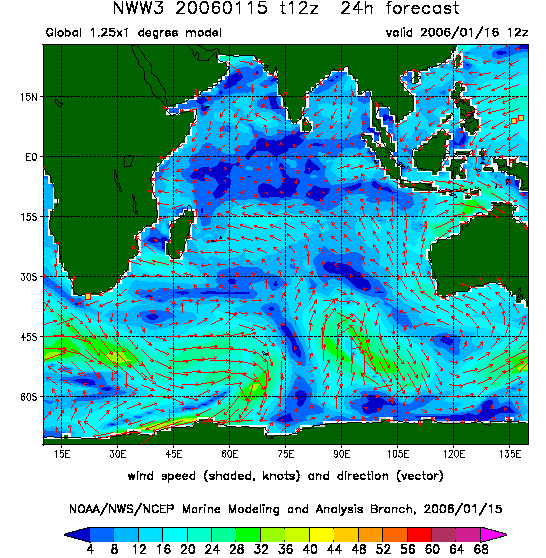
Now past the gates ABN AMBRO ONE is unconstrained in latitude and has turned sharply south through a remarkable 90 degrees. It's a bit surprising - they can surely gybe over a smaller angle. As there's no geometric reason for heading south it can only be the hunt for wind. And as can be seen from the NOAA figure below, there isn't much wind at 40S but much more at 45S.

Most importantly of all, by adding a dog leg south they can cover the pack behind, now led by the youngsters on ABN AMRO TWO.

So while the stats show the pack catching up dramatically - already a hundred miles have disappeared into sea spray - there's still only one boat dominating this leg.


Figures from Virtual Spectator and NOAA

Monday, January 09, 2006

Gates and Great Circles

One of the simplest rules of thumb for yacht navigators on ocean races is that the shortest distance is often the quickest. The other is of course to follow the winds. For leg 2 of the Volvo Ocean Race, both thumbs would be pricking with the same message - head down into the furious fifties.

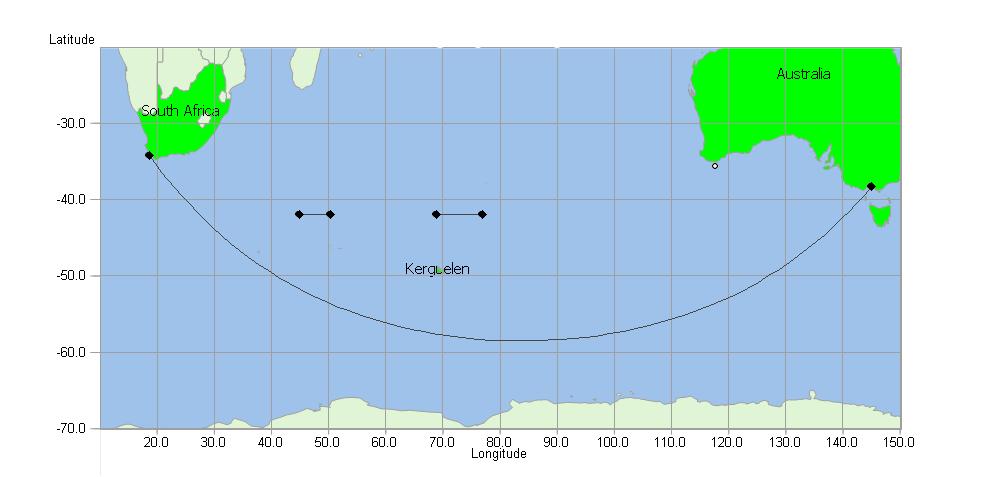
The figure below shows the direct great circle route from Cape Town to Melbourne - and its clear to sail the shortest distance you have to get down to about 58S.
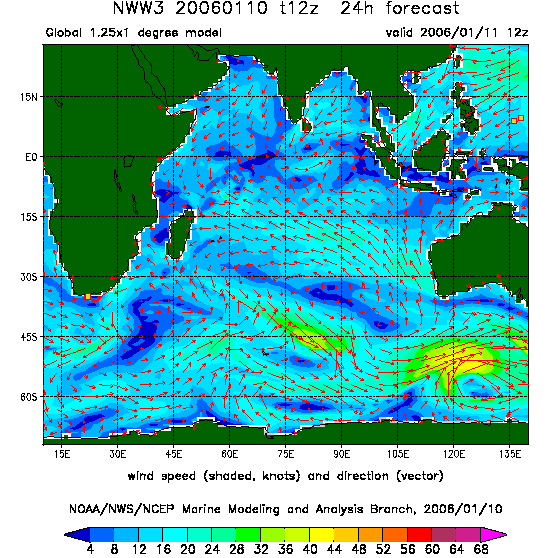
Then of course theres getting the strongest wind, and wind in the right direction. Again as the NOAA forecast below shows, a good latitude is below 50S.

But the fleet has stayed up at around 41 - 43S, where as can be seen in the graphic above the weather is the sort of mix of variability and complexity that gives navigators nightmares of sitting in a wind hole while the whole crew insists they don't blame him really.

The answer is the existence of a set of ice gates and way points as shown in the top figure. The two ice gates are both at 42S and the fleet must also round Eclipse Island forcing them much further north than their routing programs would otherwise have liked. But with ice spotted up at 47S thats probably just as well.

Meanwhile Mike and the boys on Black Betty have a stomping 326 mile lead over the Pirates who are working hard to fight off the ABN juniors just 7 miles astern.

Sunday, January 08, 2006

How far south?

Overnight ABN AMRO ONE has extended her lead over Pirates from 35 to 115 miles. Given that the gap between the leading two has changed only slowly for the previous day or so its worth asking how Mike, Betty and the boys pulled out so clearly.

To find the answer we must understand what the weather has been down there, which means looking further afield than the otherwise excellent Virtual Spectator.

As you can see in the picture above VS shows the wind direction and strength using animated coloured arrows at the time of the latest data point. VS can also show isobar contour - but alas the code behind that feature isn't compatible with my laptop, and so for me is unusable. The other problem is its only a snap-shot - it doesn't show historical data or forecast what is to come. So we must go searching the web for those that do.
This isn't always easy. Most weather forecasts cover areas of land - and populated land at that. It is only a small minority that cares what the wind strengths are in the depths of the southern oceans. However a few can be unearthed, and an answer to our question can be found.

The follow graphic comes from this site.

The fleet is currently between 41S and 43S and 46E to 52E. In this region the contours are spread out, showing weaker winds. And that is what the on-board telemetry shows: ING at the back has just 10 knots of wind.

However AMN AMRO ONE has its nose just ahead of both the fleet and the front where the contours are just a little more packed and so is sailing in 21 knots of wind. Yet again another example of "to the winners the spoils".

And what do we see coming up? From this site we get the 24 hour forecast.


We can see a finger of weak wind around 45S. Any boat that ventured south of it into the furious fifties would indeed gain much stronger wind - but at the significant risk of iceburgs. So the objective for the next day or so must be to try stay in that band of green where its a rather pleasant 30 knots. And avoid those wind holes.

Pictures from the web sites mentioned and Virtual Spectator

Friday, January 06, 2006

Foot on the floor

The Volvo fleet - or what remains of it - is now powering its way towards Melbourne. Well, maybe not as powered as many would like, for the some the sun is out, the temperature warm and the wind for the leader ABN AMRO ONE a rather mild 15 knots.

Behind them stalks a 50 knot low, as can be seen in the picture above, and its noticable that the back of the fleet has significantly stronger wind than the front.

But the depression is taking its time in catching up, so the fleet is enjoying themselves - apart from Adam Hawkins on ING Real Estate Brunel who had to dive into the freezing water to free fragments of a spinnaker wraped around the keel.

There was an interesting article at the Volvo site about how the new designs need a new approach from skippers. Less foot on the floor - more management of the boat. But is that really a change? After all a key skill of all skippers from day sailors to round the world professionals is seamanship - reef the main and reduce the size of the jib when the wind rises.

It also calls the foot on the floor approach macho, which can't be right. As the breakages of the last few days have shown, upwind is tougher than downwind. The sort of sailing that needs steel not carbon fibre. The sort of sailing currently being "enjoyed" by, er, Dee Caffari.

Pictures from Virtual Spectator

Thursday, January 05, 2006

Ice and storms

All aboard!

As the pack led by ABN AMRO ONE heads south it has already picked up the westerly conveyor belt that will accelerate them towards Melbourne.


The effect has been clearly seen in the leader's board, where movistar has dropped from first to fourth, its westerly route giving only a short term advantage.

And Moose (and his crew Skunk, Numbsy, Big Tone, Bob, Sid, Irish et al) must be pretty pleased - not just leaders but also well positioned to pick up the low building to their south-west, with strengthing winds just what their boat designers wanted.

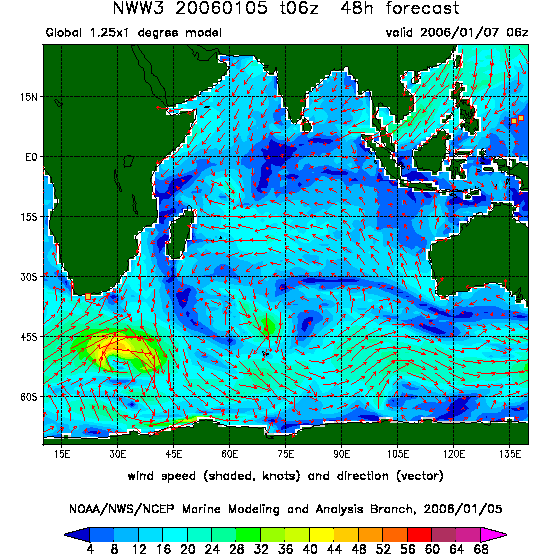
Its a long way to Oz-land, and its already been shown how these boats can break. The figure to the right shows the wind forcecast by NOAA for the 7th, where the low builds into a storm with up to 50 knot of wind.

Black Betty will have to handle storms and ice to repeat the triumphs of the last leg. And icebergs have been spotted at 49S. The boats might be still up at 43S but no one wants to crash into a growler when charging through the night at 30 knots.

But the charge to Melbourne has begun!


Pictures from Virtual Spectator and NOAA

Dee rounds the Horn

Another milestone for Dee Caffari as she rounded Cape Horn. Heading west like the buccaneers of old searching for adventure in the great wide Pacific, she also managed something she had feared she would never do - actually see the infamous island itself. For last rounding during the last Global Challenge she might have had the company of crew but alas missed seeing Cape Horn as they rounded it in the wee hours of the morning.

Thankfully she won't have to do a third circumnavigation to tick that from the list of memorable sailor's experiences, as she can now tell us all about the colour (green) the smell (seaweed) and the sounds (of Cape Horn Radio).

She even got in a photo shoot by making the day of a cruise ship called the Henseatic and was fortunate to find a gap in the storms with wind strengths of only 5 knots. Hopefully the warm glow of todays excitment will be keep her going during the long bash to windward across the southern oceans.

Picture from Aviva Challenge

Wednesday, January 04, 2006

Oops, they did it again

The start of the second offshore leg is looking a lot like the start of the first with two boats already turning back to Cape Town with structural problems. In the early hours of this morning Ericsson reported hearing a great bang which after investigations proved to be a broken keel ram piston rod. Then just after sunrise Brazil reported a crack in its hull near the cockpit, and turned its course to the north.

The fleet had been battling upwind in strong winds that contrasted with the light winds of the start. These Volvo boats are engineered using material such as carbon fibre to be as light weight as possible - good for speed but it makes sailing close hauled in heavy seas punishing for crew and boat alike.

But at least these breakages happened close to land. In a few days time the boats will be a thousand miles from any land and escape from the ceaseless pounding of wind and wave.

Tuesday, January 03, 2006

Around as well

The Volvo is not the only global race ploughing through across the seas this new year. As summer comes to the southern oceans the racing boats take their chances.

Battling her way round Cape Horn is Dee Caffari, attempting to be the first solo woman to sail westward around the world. Having sorted her broken auto-pilot, she is now faced with the less deadly problem of having no fresh bread till her oven gas pipe is fixed.


Mean while the Clipper fleet is heading out from Fremantle on its leg up to Qingdao in China via Singapore. Some of the crew of Liverpool had the dubious pleasure of the St Malo run this year with JP, and this leg sounded a lot of fun, so best wishes to them and hope they get better weather than we had!

Monday, January 02, 2006

Where's the wind?

Forget the forty knots of wind, the second offshore leg of the Volvo Ocean race has seen the boats drifting in light winds with several collisions and penalty turns. Playing bumper boats at the mark, ABN AMBRO ONE bashed into Ericsson, bending one of her stanchions then Ericsson had an incident with Brazil.

Net result - protests and a couple of 360s and 720s.

And there are over 6,000 miles of racing to go.

Catching Moose

Today the boats of the Volvo Ocean race left the warmth of Cape Town heading down into the cold of the great Southern Ocean. It's a much anticipated leg, when the new Volvo 70s will be tested in waters where the wind and waves circle the planet for ever.

With two scoring way points there are 14 points up for grabs, points that change the leader border, currently looking like this:

1

ABN AMRO ONE

15

2

Brasil 1

12.5

3

ABN AMRO TWO

12

4

Ericsson Racing Team

11.5

5

movistar

6

6=

ING Real Estate Brunel

5

6=

Pirates of the Caribbean

5


Mike Sanderson, skipper of ABN AMRO ONE and commonly known as Moose , may have a fast boat and a good position but still there are no certainties apart from the old saying that to finish first you first have to finish.

To win at this level where all boats are crewed by skilled sailors what matters is:
1) For nothing critical to break
2) For the navigator to read the weather fronts right
3) For the boat to be fast on the wind angle that dominates the leg

Its going to be an interesting race to watch - lets hope its also a safe leg.

Friday, December 02, 2005

Doh! Kids today!

Give the kids a boat and see what they do? Beat all expectations and come second in the Volvo Ocean race Atlantic leg to Cape Town, thats what. The inexperienced crew of ABN-2 seem to have had a bit of a blast: in the first night's storm "we didn’t really know how windy it was though we couldn’t get the sails down anyway".

Thats right, just enjoy the speed: "We started making a train noise every time we hit 25 knots, but after a while we got tired of it so we raised the level to 27 and we even got tired of that, so we moved it to 30".

And they have their in-port priorities in the right place - replacing a water soaked iPod: "The first thing I will do in Cape Town is buy another one because we can’t race without an iPod on board".

Ah, bless - boys with their toys.

Thursday, December 01, 2005

First to the bar

Congratulations to Mike Sanderson and the ABN-1 team who today won the Atlantic leg of the Volvo Ocean race down to Cape Town. After 6,400 miles of the tension, stress and tiredness that comes with ocean racing it was time to order those celebratory drinks - beers that the skipper and crew will have be dreaming of ever since they set out on November the 12th. It must be quite a sight - to see Table Mountain appear over the horizon, to know all their rivals are not just behind but far behind.


It's been quite a leg - that began by heading out into a storm that broke so many of the others, a fire breaking out on board, and even hitting a shark at 25 knots! Black Betty (as they have nick-named their boat) took it all in its stride - unlike the shark "mini-jaws" which alas failed to survive the encounter.

So how did they win? A number of factors seem to have helped. Firstly by throttling back during the first rough night they managed to avoid the failures that damaged so many of Black Betty's competitors - keel problems one and all. Then by delaying their gybe - till it looked they were popping over to the carribean for a holiday - they in the end gained the advantage of stronger winds. But others survived the storms and played the navigation game well, so where is their edge?

It's hard not to conclude that the ABN design team has come up with a boat faster than the others - especially when reaching, where they have a significant edge. These new Volvo 70s are stretching the technology of what can be achieved with ocean going mono hulls. The sails are so heavy that changes require almost the whole crew just to lug 100kg of weight around. The power they generate can exceed boat breaking strains, needing the skipper to consciously throttle back - hard to do when competiting against others that might be prepared to cut the risk margin to a whisker.

Over this leg records have been broken - the furthest sailed in 24 hours is now an incredible 546 miles. One wonders what they will achieve in the wild southern oceans. No doubt there is bar in Cape Town where tonight you'll here a lot of tall stories from a thirsty bunch of winners.

Tuesday, November 29, 2005

The way the wind blows

Those of you with eagle eyes will have noticed that the picture below came and went in the time it takes for a tropical squall to come and go.

The reason for the wobble was a sudden worry - was the arrow going the wrong way? For surely, surely winds rotate clockwise round a high pressure system, don't they? And if thats the case then surely the arrow should point the other way round.

Yes the wind does rotate clockwise around a high - if you're in the northern hemisphere as of course London is. Here it is simple:
High pressure = anticyclone = winds rotate clockwise
Low pressure = depression = winds rotate anti-clockwise.

However southern hemisphere all is reversed, so that:
High pressure = anticyclone = winds rotate anti-clockwise
Low pressure = depression = winds rotate clockwise.

So the picture above of the south Atlantic, with the high to the north of the low would result in winds being funnelled between them, blowing a good westerly wind that the Volvo fleet have been enjoying for the last few days.

Few! Got it right after all!

Tuesday, November 22, 2005

Who's ahead?

Well this is interesting. According to Yachting World Brazil is ahead of Ericsson in the Volvo Ocean Race, but according to the official web site its the other way round. The reason for this uncertainty is that actually no one knows - it depends how you measure it, as you can see in the Virtual Spectator plot below.


In this piccy ABN-1 are way ahead to the south. The bright green line is the advantage line which connects all the points as close to the finish as the lead boat. The finish is to the right, to the east, so the line is nearly north-south.

Brazil is the blue dot to the east of the trailing group at the top. As it is furthest right it could be claimed they are in second place as they are nearer to the green line than any other boat.

But then again all the boats are heading south, and in this direction the Ericsson orange blob is ahead of Brazil. So in that case it is Ericsson that is is second place as its got further south than any of the trailing pack.

Who is right? It depends upon what happens next. At the moment the high is close to the Brazilian coast, but soon its due to move away, possibly opening up a passage between weather systems accelerating the boats that are in the right place at the right time towards the finish line. At some point the wind will back more and more westerly and the boats will veer off.

One way of looking at it is if Ericsson beared up to the wind and Brazil followed suit when it got to the same latitude who would be ahead. I think it would be Ericsson - just. So I think its Ericsson which is second. But the key now is to steer for boat speed, to get as quickly south as possible. But if you can get the same boat speed by heading a little more easterly then go for it. Brazil is playing its cards well and I'm sure Neal is looking over his shoulder anxiously.

Monday, November 21, 2005

The road south

The lead four Volvo boats have now passed the way point of Fernando de Noronha and are free to steer straight for Cape Town. But they have not, they are heading south as fast as they can.

You can see why in the weather chart from Virtual Spectator figure below.


The South Atlantic high, that often resides close to the island of St. Helena, drives the winds hard on the nose of any boat that would try the direct path. So it's faster to head south till its time to turn to port. But when? thats will be the next question for navigators to ponder over, when to turn?

But that decision is not yet, as for the next few days they'll be following the same track one after the other with few opportunities to pass. Pure boat speed will drive which boat comes 2nd, 3rd and 4th. But not 1st, where ABN-1 has a clear 80 miles over Ericsson.

Friday, November 18, 2005

Bye Bye Twin

There is a clear leader in leg 1 of the Volvo ocean race - ABN AMRO ONE. The last two days they have sprinted into a 100 mile lead, but how?

Two reasons spring to mind. Firstly by gybing later they paid the price of greater distance but gained the prize of higher pressure. If you look at the stats on Virtual Spectator at 17:00 on 16/11/05 the average wind speed for the ABN twins was around 18 knots while Brazil, then in the lead, it was only around 11 knots. And ABN-1 used that to boost their VMG by a couple of knots, taking the lead away over that night.

And to just kept on going. For there was more than just positioning as ABN-2 at dusk was side by side but by dawn fell back to last position. Its sister ship seems a bit of a flyer, maybe using the new technology better, or having used well the chance to train and test ideas against her twin.

Bad news for the other competitors. They might hope ABN-1 get bogged down in the doldrums, but as the Transat Jacque Vabre showed, these can be transitioned quickly at the moment, and the Volvo fleet seems to be heading for a similar crossing point that got Ellen and the Open 60s through with so few problems.

But there's still a long way to go and the route past Fernando de Noronha when many will remember the last time and the old saying of if in doubt head south. Or less prosaically head south to avoid the St Helena high.

Tuesday, November 15, 2005

Erratic Ericsson

What's up with Ericsson? Today they've gybed 12 times which no one does given the effort and distance lost each time. Is another keel experiencing problem?

Oh, and the ABN twins - they did gybe, just as predicted

Gybe ho!

Yup, as forecast by Captain JP last night the Volvo fleet has began to gybe onto port tack to head deeper south. So far just Brazil and Ericsson have taken the plunge (Ericsson strangely changing its mind many times) while the ABN twins are heading increasingly west. As they find the wind veering further east they too must soon follow suit.

Monday, November 14, 2005

Following the fleet

Long distance ocean racing is not for the comfort loving or faint of heart. To become a slave of the cult for VMG(*), changing sails night and day, watches repeating like clockwork, smelly bunks where you grab too short naps, bad food and worse heads, all is sacrificed for the endless pressure for speed whatever the time or weather, continuous day after day for weeks on end.

And thats just when things are good, when things aren't breaking for against the power of wind and wave even carbon fibre can crumple, and the mere human flung like dolls across cockpit at the mercy of the extreme loads on spars, ropes and sails.

But it is gripping too - to battle against the forces of nature, to use technology, brawn and brain to overcome the elements and competition across the wide oceans to win both trophies and pride. So its great to be able to taste the excitment and thrills while staying in the warm and comfort of home.

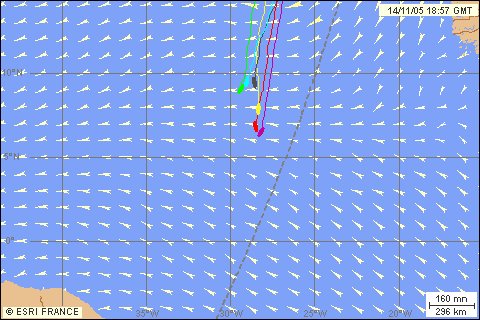
The web has proved a natural home for following the far flung fleets. A typical plot is shown below taken from the Transat Jacque Vabres. It shows the lead Open 60s as of 14th November 2005. You can see their direction, track, and route line. This site is better than many as you can overlay the wind direction and strength for the next few days.


This helps you appreciate the race better by seeing the tatics played out in front of you. So Jean and Ellen are both heading nearly due south - why? Well they are entering the doldrums so it could be local conditions - squalls to avoid. But it could also be to get a better wind angle when they emerge from it so they can reach towards Brazil.

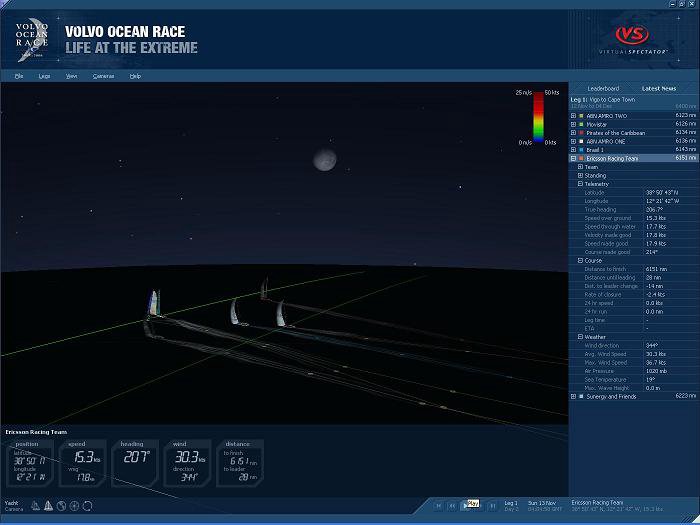
But this level of information has been blown away by the absolutely amazing Volvo free software Virtual Spectator. This gives a 3D interactive tool which shows boats sailing under moon and stars, linked into instruments and database of positions.


It's not just good to look at, it really does give a better idea about what is happening. It was clear from VS that Ericsson had had a minor problem because their track paused for about half an hour - just what you'd expect from the "issue with a sail and a halyard" admitted to a day later. And by overlaying the fleet's position, wind direction and tack you can think yourself into the navigator's head as they ponder the big question of the day: when to gybe?

Must be soon.

(*) VMG = Velocity Made Good - how fast you are going in the direction of the destination

Saturday, November 12, 2005

Racing through the vortex

I've twice sailed the seas around the Canary Islands and both times thoroughly enjoyed it. Its warm without being hot and with good winds - most of the time. The first time I sailed there was a week on one of the Challege 67 boats pottering between the islands, while the second was the start of the Atlantic Rally for Cruisers, or ARC, heading out across an ocean to reach St Lucia 3 weeks later.

But for ocean races it's often just an annoying obstacle. The Transat Jacques Vabre fleet had to pass these islands on its way to Brazil recently and yet again some of them were caught out unawares. For though the wind can blow well it can also disappear, and from sea level it's sometimes hard to predict where and why.

But from space the reason is clear as can be seen in the satellite photo below.


This picture shows clearly what are called von Karman vortices. These naturally form when a fluid flow is disturbed by an object, causing vortices to form alternately on either side down stream. In this case the object is the volcanic peaks of the Canary Islands and the flow is the trade winds from the North East. The result is disturbed air, especially to the South East.

More on this effect can be found here.

From watching fleets from the Volvo to the Global Challange the message is often quite simple: keep clear of islands with high mountains. Or see your position drop down the vortex.

Wednesday, November 09, 2005

Pieces of orange

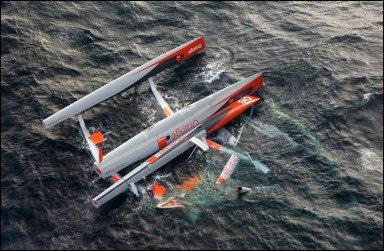
This is what can happen to a multi-hull when flipped by a storm. In this case its Project Orange, which got hit by the legendary bad weather of the Bay of Biscay at the start of the Transat Jacques Vabre.

One reason I'd rather be in a mono-hull when the going gets rough.

Tuesday, November 08, 2005

Sail Away

And they're off! Not one but three ocean races have started recently.

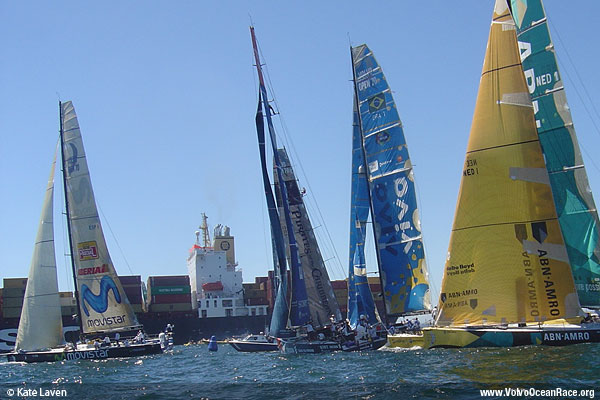
The biggest of all, the Volvo, had its first leg this weekend. This is the fully crewed, multiple stop round the world yacht race with a history going back to the seventies, when it was known as the Whitbread. Then it was near amateur, with proper galleys and space for bottles of wine. Now it is intense full-on professional, with hot bunking and freeze dried food. Now also there are inshore legs, to bring a bit of instant fix for the following media.

First blood went to Ericsson skippered by veteran Neal McDonald who so successfully turned round the Assa Abloy campaign in the last race. There is also a new class of boats - the 70 footers - amazing machines. We had the experience of being overtaken by one when doing the Fastnet - beautiful boat.

Then there's the Transat Jacques Vabre, crossing the Atlantic from France to Brasil. This is one of those events known to serious sailors but little known outside. It has a host of names - Ellen MacArther and Mike Golding are just two of the Brits. Already there has been drama with a number of multi-hulls having to retire following damage in a storm. These trimarans are fast and furious, but dangerous in bad weather where squalls can lead to flips and breakages.

Finally there's the Clipper race 05-06, where an all amateur crew pay around 25k pounds to spend a year getting cold, wet and tired. But they escape the daily grind of work and emails, which is forcing this post to finish just here!

(picture from here)