My first off-line question after the talk on the history of London's sewers was to what degree did Bazalgette use the work of John Martin? This triggered much interest from the historian who started drawing figures of pipes of different sizes and heights in the Embankment, as apparently John Martin got this bit wrong.
The key thing is that there isn't really just the one system as there are multiple levels on each side of the Thames. In an ideal world there would be a constant, gradual, incline in the pipes ending up at the outfall with the height equal to high water at Beckton and Crossness. This is clearly not feasible given that much of low lying London is below that level.
Hence one of the key aspects of Bazalgette's design (that Martin missed) was to have these multiple levels and then pumping stations to lift lower level wast up to a higher level where it could then flow downwards.
At Beckton and Crossness the inflows ended up at a low level and so had to be pumped up to fill lagoons until the tide was high enough that the outflows would go out to sea rather than back into London.
The result was a web of pipes, the largest of which can be seen in the figure above. At Abbey Mills there are pumps that raise the waste up to a height where it can then move by gravity down to Beckton along the northern outfall sewer (more of this anon).
These pumps are pretty impressive and some of the old ones were on display like this, looking very like large metallic ammonites:
Within Abbey Mills itself there were lots of dials and control identifying the heights of the various flows to control the system:
Getting it wrong would not just be messy but could lead to flooding of low lying parts of London - where indeed several of the Thames Water staff lived. So they were clearly highly motivated to ensure the system was working efficiently!
Of course this system and map are now creaking at the seams which is why we have the Thames Tideway Tunnel aka the Super Sewer.
Thursday, June 01, 2017
Wednesday, May 31, 2017
London History Day: The Sewers
Today is London History Day!
In case you're wondering, no you haven't been missing LHD all those years as its the first ever, and no its not been thought up by some PR company but rather a poll of the great British public.
Given my recent trip down the sewers there could be only be one topic to cover, and fortunately the Thames Water event included a very interesting talk by Ben Nithsdale on this very subject.
Very informative it was too. For example, I didn't realise that historically the word sewer didn't mean transport of human waste but a means of land drainage e.g. of rain water. And that was the case for those old Greek and Roman stone piping in the streets (plus those storm drains that The Terminator sped down on a motorbike).
In ye olde London water was expensive and delivered mostly by cart or even buckets while the waste (as I shall call it) was simply tipped into the streets. People got fed up with this but given the technology of the day (1388) the solution was just to hire men with rakes.
However in 1580 piped water was provided to streets of the City pumped via a water mill on the north end of London Bridge and this was followed by other schemes, typically using wooden drilled pipes that only ran for a few hours a week. They leaked a lot and so were unpressurised and laid along the street by the curb.
Henry VIII, when not distracted by his complex marriage affairs, was instrumental in the development of the sewers by giving commissions the right to dig sewers where they needed. These were for drainage and clean water and at this time the Thames would have been drinkable and full of fish - hence Billingsgate Market located on the riverbank in the City.
Human waste, instead of going into the street, was increasingly held in cesspits, but these tended to overflow, often into sewers, which was illegal. Water consumption rocketed as wooden pipes were replaced by iron ones, which could be pressurised and transport water from far outside the capital.
But as London boomed in 1815, the year Napoleon was defeated at Waterloo, there was another dramatic change, as it became legal to pipe waste into the sewers, which in a few years become overloaded and filthy.
Famously, the artist John Martin foresaw that with the rapid increase in London's population this would require engineering to solve but he was to be ignored. It wasn't until politicians themselves were driven from Westminster by the Great Stink of 1858 that it was decided that Something Had To Be Done.
And so it was that Bazalgette started designing the great combined sewage system, that included the magnificent Abbey Mills Pumping Station:
More tomorrow...
In case you're wondering, no you haven't been missing LHD all those years as its the first ever, and no its not been thought up by some PR company but rather a poll of the great British public.
Given my recent trip down the sewers there could be only be one topic to cover, and fortunately the Thames Water event included a very interesting talk by Ben Nithsdale on this very subject.
Very informative it was too. For example, I didn't realise that historically the word sewer didn't mean transport of human waste but a means of land drainage e.g. of rain water. And that was the case for those old Greek and Roman stone piping in the streets (plus those storm drains that The Terminator sped down on a motorbike).
In ye olde London water was expensive and delivered mostly by cart or even buckets while the waste (as I shall call it) was simply tipped into the streets. People got fed up with this but given the technology of the day (1388) the solution was just to hire men with rakes.
However in 1580 piped water was provided to streets of the City pumped via a water mill on the north end of London Bridge and this was followed by other schemes, typically using wooden drilled pipes that only ran for a few hours a week. They leaked a lot and so were unpressurised and laid along the street by the curb.
Henry VIII, when not distracted by his complex marriage affairs, was instrumental in the development of the sewers by giving commissions the right to dig sewers where they needed. These were for drainage and clean water and at this time the Thames would have been drinkable and full of fish - hence Billingsgate Market located on the riverbank in the City.
Human waste, instead of going into the street, was increasingly held in cesspits, but these tended to overflow, often into sewers, which was illegal. Water consumption rocketed as wooden pipes were replaced by iron ones, which could be pressurised and transport water from far outside the capital.
But as London boomed in 1815, the year Napoleon was defeated at Waterloo, there was another dramatic change, as it became legal to pipe waste into the sewers, which in a few years become overloaded and filthy.
Famously, the artist John Martin foresaw that with the rapid increase in London's population this would require engineering to solve but he was to be ignored. It wasn't until politicians themselves were driven from Westminster by the Great Stink of 1858 that it was decided that Something Had To Be Done.
And so it was that Bazalgette started designing the great combined sewage system, that included the magnificent Abbey Mills Pumping Station:
More tomorrow...
Thursday, May 25, 2017
Visiting Bazalgette's magnificent sewers
Regular readers will be well aware of my fascination with the life of John Martin, his pioneering work on London's sewer system, how it was taken up by Bazalgette in the great Victorian engineering project encapsulated by the wonderful Grade 1 Listed Crossness Pumping Station.
Readers might also have also spotted my interest in London Under, from Brunel's Thames Tunnel to disused tube stations and canal tunnels to the lost rivers of London.
So hopefully it will be at least partially understandable that high on my list of places to visit in London would be Bazalgette's magnificent sewers.
It was therefore with great excitement that I received an invite from Thames Water for just such a tour.
We started off at the Grade II listed Abbey Mills pumping station, which was once known as the "mosque in the marshes" due to its elegant dome at the top:
Inside there is much of the original metal work, but unlike Crossness this pumping station has been continually in operation, so there are also more modern pumps filling its cavernous spaces:
We were given an extremely interesting history of how London managed its water supply and, er, corresponding wastage (to put it delicately). There was also an update on the famous Thames Tideway Tunnel aka the Super Sewer, more of which anon, including what will happen to the Bubbler.
The tour then showed us the site's main buildings and their history. There used to be two tall chimneys but they had to be demolished in the Blitz because of concerns that if they were damaged they might fall on the pumping station itself.
Then it was time to get dressed up for the descent into London under and the sewers. The outfit made us all feel a bit like the Ghostbusters - who are you going call? - very comprehensively covered, with not just one but two gloves, which to be honest made operating the camera a bit frustrating.
Anyhow managed to get a few shots with approximately the right settings:
I'm sure you're wondering about the smell but it really wasn't that bad. They'd lowered the water level but we still to wade through a foot or two of brown water, and it wasn't just Thames mud giving it its colour I'm sure. So we were all very incentivised not to fall over or in.
Our guide showed us the Bazalgette original brick work (top photo), looking good after about 150 years and still doing its job to keep the dirty stuff out of the Thames. We also got a lesson in what not to flush down the drain, complete with examples.
More on all of this later, as there was lots of really interesting information provided over the afternoon and I have a stack of photos and videos to, er, wade through.
Many thanks to Thames Water for arranging the tour.
Readers might also have also spotted my interest in London Under, from Brunel's Thames Tunnel to disused tube stations and canal tunnels to the lost rivers of London.
So hopefully it will be at least partially understandable that high on my list of places to visit in London would be Bazalgette's magnificent sewers.
It was therefore with great excitement that I received an invite from Thames Water for just such a tour.
We started off at the Grade II listed Abbey Mills pumping station, which was once known as the "mosque in the marshes" due to its elegant dome at the top:
Inside there is much of the original metal work, but unlike Crossness this pumping station has been continually in operation, so there are also more modern pumps filling its cavernous spaces:
We were given an extremely interesting history of how London managed its water supply and, er, corresponding wastage (to put it delicately). There was also an update on the famous Thames Tideway Tunnel aka the Super Sewer, more of which anon, including what will happen to the Bubbler.
The tour then showed us the site's main buildings and their history. There used to be two tall chimneys but they had to be demolished in the Blitz because of concerns that if they were damaged they might fall on the pumping station itself.
Then it was time to get dressed up for the descent into London under and the sewers. The outfit made us all feel a bit like the Ghostbusters - who are you going call? - very comprehensively covered, with not just one but two gloves, which to be honest made operating the camera a bit frustrating.
Anyhow managed to get a few shots with approximately the right settings:
I'm sure you're wondering about the smell but it really wasn't that bad. They'd lowered the water level but we still to wade through a foot or two of brown water, and it wasn't just Thames mud giving it its colour I'm sure. So we were all very incentivised not to fall over or in.
Our guide showed us the Bazalgette original brick work (top photo), looking good after about 150 years and still doing its job to keep the dirty stuff out of the Thames. We also got a lesson in what not to flush down the drain, complete with examples.
More on all of this later, as there was lots of really interesting information provided over the afternoon and I have a stack of photos and videos to, er, wade through.
Many thanks to Thames Water for arranging the tour.
Tuesday, May 23, 2017
Sunday, May 21, 2017
Boating weather
The weather has finally warmed up and the boats are out on the Thames.
All it needs now is for my workload to decrease!
Sunday, May 14, 2017
Paddle boat Italie on Lake Geneva
I have previously posted comments about paddle steamers, the authentic and the total fakes.
On Lake Geneva there is, fortunately, a lovely "Belle Epoque" fleet of side paddle boats, such as the Italie, seen here up by the famous Jet d'Eau:
Alas I was working far to hard to go for a trip (or alternatively investigate the D35 cats racing out on the Lake) but it made a nice distraction when going for a walk or jog.
On Lake Geneva there is, fortunately, a lovely "Belle Epoque" fleet of side paddle boats, such as the Italie, seen here up by the famous Jet d'Eau:
Alas I was working far to hard to go for a trip (or alternatively investigate the D35 cats racing out on the Lake) but it made a nice distraction when going for a walk or jog.
Thursday, May 04, 2017
Two lessons from my first yacht sail
A long time ago, in a country far, far away.....
Ok, enough May the fourth misquotes, but many years ago I signed up for something called Villa-Flotilla holiday where the first week involved teaching newbies how to sail a yacht and the second off we'd go.
It was for a sailing company that is now long gone but others still sail from where it was based, namely Nidri on the Greek island of Lefkas (Lefkada).
I'd never been on a yacht before but was keen to find out more from our instructor, on who we relied to teach us the mysteries of sailing.
Unfortunately the first thing he did was run our yacht aground just outside Nidri! So the first topic of my first sailing lesson was how to kedge off. Fortunately I haven't had to use this technique since but no doubt it was useful to know.
The second lesson was the all important person over-board drill. Most courses simulate a body by tying a fender to a bucket then chucking it into the waters, but our instructor was a bit more ambitious in that he jumped over-board himself.
I do wonder what would have happened if we had been poor students at that task.
Later I was to learn other important things, such as why it was a bad idea to crash-gybe in front of an oncoming Greek ferry, but that's another story.
Ok, enough May the fourth misquotes, but many years ago I signed up for something called Villa-Flotilla holiday where the first week involved teaching newbies how to sail a yacht and the second off we'd go.
It was for a sailing company that is now long gone but others still sail from where it was based, namely Nidri on the Greek island of Lefkas (Lefkada).
I'd never been on a yacht before but was keen to find out more from our instructor, on who we relied to teach us the mysteries of sailing.
Unfortunately the first thing he did was run our yacht aground just outside Nidri! So the first topic of my first sailing lesson was how to kedge off. Fortunately I haven't had to use this technique since but no doubt it was useful to know.
The second lesson was the all important person over-board drill. Most courses simulate a body by tying a fender to a bucket then chucking it into the waters, but our instructor was a bit more ambitious in that he jumped over-board himself.
I do wonder what would have happened if we had been poor students at that task.
Later I was to learn other important things, such as why it was a bad idea to crash-gybe in front of an oncoming Greek ferry, but that's another story.
Wednesday, May 03, 2017
Boats! Boats! Boats! .... in Corfu
From a flying visit last weekend. Many, many years ago I did a villa-flotilla on nearby Lefkada which might be worth a post.
Friday, April 28, 2017
Photography update: A6500 with dead cat and Sony's A9 game changer
Time for another of the occasionally blog posts on photography and after recent mention of a dead cat I thought I show you what mine looks like.
Above is my Sony A6500 (upgraded from the A6300 & A6000) with external microphone attached and its wind muffler aka a dead cat when sailing on the the tall ship Zephyr a couple of weekends ago.
It seemed as good as excuse as any to mention the launch of Sony's A9, very much the big brother of the A6500. For those that don't haunt the photography blogs and vlogs, this has led to phrases like game changer being used a lot, but with good reason.
Up to the A9 there were many asking of mirrorless cameras (like both the A6500 and A9) why not get a DSLR with its mirror and mechanical shutter. After the A9 the question it seems fair to reverse the question: why would you want to have a mirror?
The A9 can take full frame images faster than a DSLR thanks to on-chip memory that can pipe data off the sensor using a fully electronic shutter: no noise, shake or rolling shutter. And the view finder updates with no blanks, unlike DSLR that goes dark as the mirror flips up and down.
With a mirrorless camera you can do a whole host of additional features from video (*), silent shooting, focus peaking, zebraing, continuous EVF, touch to focus etc.... You get to see the image as it will be taken before you take the photo, complete with histogram, so have to chimp less.
And cameras can be smaller and lighter: the A6500 above fits in the palm of my hand but is a complete 4K video setup with in-body stabilisation (**), monster burst rate, low noise night time shooting...
Of course requirements differ and there are a couple of things that Sony need to work on for the A6500ii or whatever they call it:
There is no such thing as a perfect camera, but Sony are doing some really interesting things at the moment: disruptive and innovative.
(*) ok, you can do video with a DSLR, but you have to lock the mirror up. So it effectively is a mirrorless camera with a bit of weight hanging around.
(**) ok, it might not of looked it from the video posted earlier, but that's my fault.
Above is my Sony A6500 (upgraded from the A6300 & A6000) with external microphone attached and its wind muffler aka a dead cat when sailing on the the tall ship Zephyr a couple of weekends ago.
It seemed as good as excuse as any to mention the launch of Sony's A9, very much the big brother of the A6500. For those that don't haunt the photography blogs and vlogs, this has led to phrases like game changer being used a lot, but with good reason.
Up to the A9 there were many asking of mirrorless cameras (like both the A6500 and A9) why not get a DSLR with its mirror and mechanical shutter. After the A9 the question it seems fair to reverse the question: why would you want to have a mirror?
The A9 can take full frame images faster than a DSLR thanks to on-chip memory that can pipe data off the sensor using a fully electronic shutter: no noise, shake or rolling shutter. And the view finder updates with no blanks, unlike DSLR that goes dark as the mirror flips up and down.
With a mirrorless camera you can do a whole host of additional features from video (*), silent shooting, focus peaking, zebraing, continuous EVF, touch to focus etc.... You get to see the image as it will be taken before you take the photo, complete with histogram, so have to chimp less.
And cameras can be smaller and lighter: the A6500 above fits in the palm of my hand but is a complete 4K video setup with in-body stabilisation (**), monster burst rate, low noise night time shooting...
Of course requirements differ and there are a couple of things that Sony need to work on for the A6500ii or whatever they call it:
- Screen that flips round
- Extra control dial(s)
- 16-50 F2.8 APSC zoom
- A long APSC zoom lens
There is no such thing as a perfect camera, but Sony are doing some really interesting things at the moment: disruptive and innovative.
(*) ok, you can do video with a DSLR, but you have to lock the mirror up. So it effectively is a mirrorless camera with a bit of weight hanging around.
(**) ok, it might not of looked it from the video posted earlier, but that's my fault.
Labels:
blogging,
photography
Monday, April 24, 2017
Tall Ships 2017 Video
I haven't posted a video for a long time but put together this short from clips taken on the trip on the Zephyr during the Tall Ships 2017.
Not that I'm going to follow Sassi's advice or anything.
What do you think?
Sunday, April 23, 2017
Tall Ships 2017: Mermaids, pirates and more
During the Tall Ships 2017 as well as lots to see out on the Thames there was also entertainment ashore.
Before joining the Zephyr I had a look around the site at Woolwich Arsenal and first up was the mermaid above. She had her own bubble that magically (er, well if you ignore the electric motor and controls to hand) transported her among puzzled children, many of whom were asking "But WHO is she, mummy?"
Also there was this pirate who had clearly seen one too many Johnny Depp movie:
He was part of an ensemble of actors in period dress acting out scenes - such as policemen arresting a criminal - and these milkmaid and woman smoking a pipe:
The milkmaid was very interested in my dead cat - the type on camera microphones I hasten to point out.
There were also all sorts of bands playing lots of different types of music:
It was great to see lots of families coming down to see the boats for the Easter weekend.
Before joining the Zephyr I had a look around the site at Woolwich Arsenal and first up was the mermaid above. She had her own bubble that magically (er, well if you ignore the electric motor and controls to hand) transported her among puzzled children, many of whom were asking "But WHO is she, mummy?"
Also there was this pirate who had clearly seen one too many Johnny Depp movie:
He was part of an ensemble of actors in period dress acting out scenes - such as policemen arresting a criminal - and these milkmaid and woman smoking a pipe:
The milkmaid was very interested in my dead cat - the type on camera microphones I hasten to point out.
There were also all sorts of bands playing lots of different types of music:
It was great to see lots of families coming down to see the boats for the Easter weekend.
Tuesday, April 18, 2017
Parade of Sail for the Tall Ships 2017
The final event was a parade of sail in which all the ships went up the Thames and then back down passing the Royal Naval College, with some crewing the yards, as in the photo above.
Others went out onto the bowsprit to wave at the crowds on either side of the river:
Not all had sails up, but some did, including this caravel, the Vera Cruz:
Having sailed on Zephyr I looked out especially to see it sail by:
And then they were gone, leaving Greenwich with just the one, the Cutty Sark, frozen in its glass sea...
Monday, April 17, 2017
Tall Ship Festival 2017
For some reason I've missed most of the visits of the Tall Ships to London - partly due to busy schedule and partly being off sick. But they were visiting this Easter and everything worked out so managed to get on board one from Woolwich to Greenwich and back.
On the grounds that if you don't ask you don't get a chance I asked if I could steer and so just after the photo above (between the O2 Dome and Greenwich) to just before the Thames Barrier I was at the rather large wheel.
It was rather interesting as the river was busy with other tall ships which had to overtake or steer between, a number of naval vessels heading up river and the usual Thames Clippers zipping up and down river.
It was bit cloudy but that didn't stop it being a fun way to spend an afternoon.
On the grounds that if you don't ask you don't get a chance I asked if I could steer and so just after the photo above (between the O2 Dome and Greenwich) to just before the Thames Barrier I was at the rather large wheel.
It was rather interesting as the river was busy with other tall ships which had to overtake or steer between, a number of naval vessels heading up river and the usual Thames Clippers zipping up and down river.
It was bit cloudy but that didn't stop it being a fun way to spend an afternoon.
Friday, April 14, 2017
The meaning of the Old Royal Naval College Painted Hall
The amazing Painted Hall at the Old Royal Naval College is full of amazing imagery and on my recent tour some it was explained by our guide. Alas not all was explained (or remembered) so in this post there are some diversions when I had to fill in my own stories.
Lets start with the end wall (above) and have a look at the bottom right where you can see this figure:
This is a self portrait of the artist James Thornhill. There was probably some symbolism or etiquette to explain the hand gesture but my take was he was asking to be paid.
At the centre is King George and to the left of him these children:
These were actually a big political point. The one thing that the royals have to do is have children. Other problems, including going mad, is something the system can work around. Alas the problem with William and Anne was the lack of offspring. Anne in particular had 17 children but sadly none survived.
So when the House of Hanover took over they were keen to demonstrate that this wouldn't be a problem for them.
I suspect that the globe was the standard imperial pretensions - unless it was for the children planning their gap year travels.
This scene was not explained:
I'm going with the story of how a resourceful thief bared her breast to distract the king while stealing his gold stick with jewels in it thing.
Up on the ceiling the east end had a spot of astronomy and astronomers in it. The guide asked why it was that sailors might be interested to know about the movement of the moon and I'm sure you know why to and you'd be welcome to say so in the comments section.
For example there was this figure:
This relates to the Astronomer Royals prediction of a solar eclipse, complete with date and year. It was suggested that this was a bit of a hostage to fortune as if it didn't happen and had been painted on the ceiling it would be visible for ever and ever.
Fortunately it did happen, though the date was actually "wrong" as Britain was using the old Gregorian calendar.
Nearby was this old sailor:
Apparently he was a bit of a trouble maker so the hospital wanted to find him something to keep him occupied for a bit. It was apparently successful - but only for the duration of the sitting, and then he returned to his usual drinking etc.
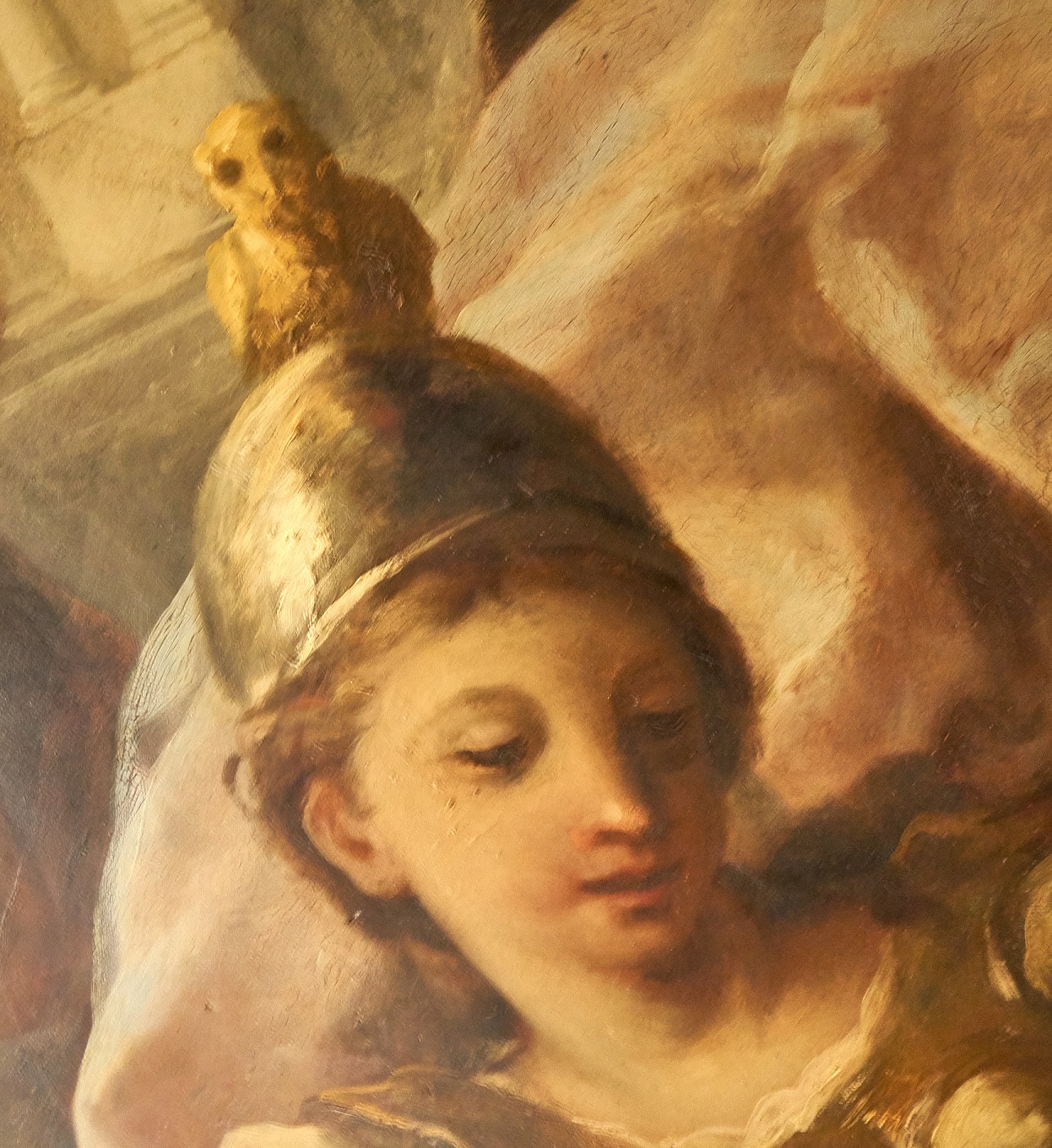
But its an interesting thought that some of the characters shown in these figures would have been based upon real people that walked the streets of London. So who was this woman with the owl on her head?
Curiously enough while passing the Cutty Sark on my way to the Painted Hall I saw a stand from a local bird sanctuary and they had an owl too.
Greenwich is indeed one place where you can feel connected to the long and rich history of London.
Lets start with the end wall (above) and have a look at the bottom right where you can see this figure:
This is a self portrait of the artist James Thornhill. There was probably some symbolism or etiquette to explain the hand gesture but my take was he was asking to be paid.
At the centre is King George and to the left of him these children:
These were actually a big political point. The one thing that the royals have to do is have children. Other problems, including going mad, is something the system can work around. Alas the problem with William and Anne was the lack of offspring. Anne in particular had 17 children but sadly none survived.
So when the House of Hanover took over they were keen to demonstrate that this wouldn't be a problem for them.
I suspect that the globe was the standard imperial pretensions - unless it was for the children planning their gap year travels.
This scene was not explained:
I'm going with the story of how a resourceful thief bared her breast to distract the king while stealing his gold stick with jewels in it thing.
Up on the ceiling the east end had a spot of astronomy and astronomers in it. The guide asked why it was that sailors might be interested to know about the movement of the moon and I'm sure you know why to and you'd be welcome to say so in the comments section.
For example there was this figure:
This relates to the Astronomer Royals prediction of a solar eclipse, complete with date and year. It was suggested that this was a bit of a hostage to fortune as if it didn't happen and had been painted on the ceiling it would be visible for ever and ever.
Fortunately it did happen, though the date was actually "wrong" as Britain was using the old Gregorian calendar.
Nearby was this old sailor:
Apparently he was a bit of a trouble maker so the hospital wanted to find him something to keep him occupied for a bit. It was apparently successful - but only for the duration of the sitting, and then he returned to his usual drinking etc.
But its an interesting thought that some of the characters shown in these figures would have been based upon real people that walked the streets of London. So who was this woman with the owl on her head?
Curiously enough while passing the Cutty Sark on my way to the Painted Hall I saw a stand from a local bird sanctuary and they had an owl too.
Greenwich is indeed one place where you can feel connected to the long and rich history of London.
Tuesday, April 11, 2017
Restoring the Old Royal Naval College Painted Hall
Previously I blogged my first visit to the famous Painted Hall at the Old Royal Naval College in Greenwich. The reaction was pretty much:
O! M! G!
I can see why they call it the Sistine Chapel of London. The photo above shows just one end of the hall: the ceiling is equally epic. It was painted by James Thornhill at the rather bargain price of "£7000, based on a rate of £1 per square yard for the walls and £3 per square yard for the ceilings".
But alas since completion in 1727 it has had to put up with the "old smoke" and time has not been kind, so parts look a bit like this:
How do I know this? Well it is currently being restored and they are running tours up the scaffolding to have a look up close to the ceiling:
If you follow this link to the old post there's a photo of the ceiling and you can see this figure at the top left, who is Apollo the sun god.
The guide gave a detailed description of the paintings which I've pretty much forgotten but will give it a go in the next post. I might get quite a bit wrong....
O! M! G!
I can see why they call it the Sistine Chapel of London. The photo above shows just one end of the hall: the ceiling is equally epic. It was painted by James Thornhill at the rather bargain price of "£7000, based on a rate of £1 per square yard for the walls and £3 per square yard for the ceilings".
But alas since completion in 1727 it has had to put up with the "old smoke" and time has not been kind, so parts look a bit like this:
How do I know this? Well it is currently being restored and they are running tours up the scaffolding to have a look up close to the ceiling:
If you follow this link to the old post there's a photo of the ceiling and you can see this figure at the top left, who is Apollo the sun god.
The guide gave a detailed description of the paintings which I've pretty much forgotten but will give it a go in the next post. I might get quite a bit wrong....
Saturday, April 08, 2017
Boats! Boats! Boats! ... on the Thames above Hampton Court Bridge
Thursday, April 06, 2017
Tillerman has gone quiet, but apparently the hits on his blog have gone up.
The lesson is clear - less is more.
So how many hits can a blank post receive?
There was clearly only one way to find out...
The lesson is clear - less is more.
So how many hits can a blank post receive?
There was clearly only one way to find out...
Tuesday, April 04, 2017
The 2017 University Boat Race
There's a great atmosphere in Putney on Boat Race day.
Out on the water officials are getting ready - or, by the looks of it, enjoying the sun, checking their social media and having a bit of a feet up rest.
On land there's that all important ceremony: the official Carrying Of The Welly Boots:
Can't imagine how I didn't manage to see that at earlier races.
There's a friendly spirit all round - even the police boat, best known for their catch-phrase "you're nicked, sunshine" were spotted have a friendly wave to someone or other.
Jolly good. Pimms or bubbly or a good old fashioned pint all round.
Out on the water officials are getting ready - or, by the looks of it, enjoying the sun, checking their social media and having a bit of a feet up rest.
On land there's that all important ceremony: the official Carrying Of The Welly Boots:
Can't imagine how I didn't manage to see that at earlier races.
There's a friendly spirit all round - even the police boat, best known for their catch-phrase "you're nicked, sunshine" were spotted have a friendly wave to someone or other.
Jolly good. Pimms or bubbly or a good old fashioned pint all round.
Monday, April 03, 2017
The 2017 University Boat Race
Two quick photos from yesterday's boat race.
In the women's race the Cambridge team (above) was so far ahead of Oxford I couldn't get boat boats in frame at the same time. Just brilliant!
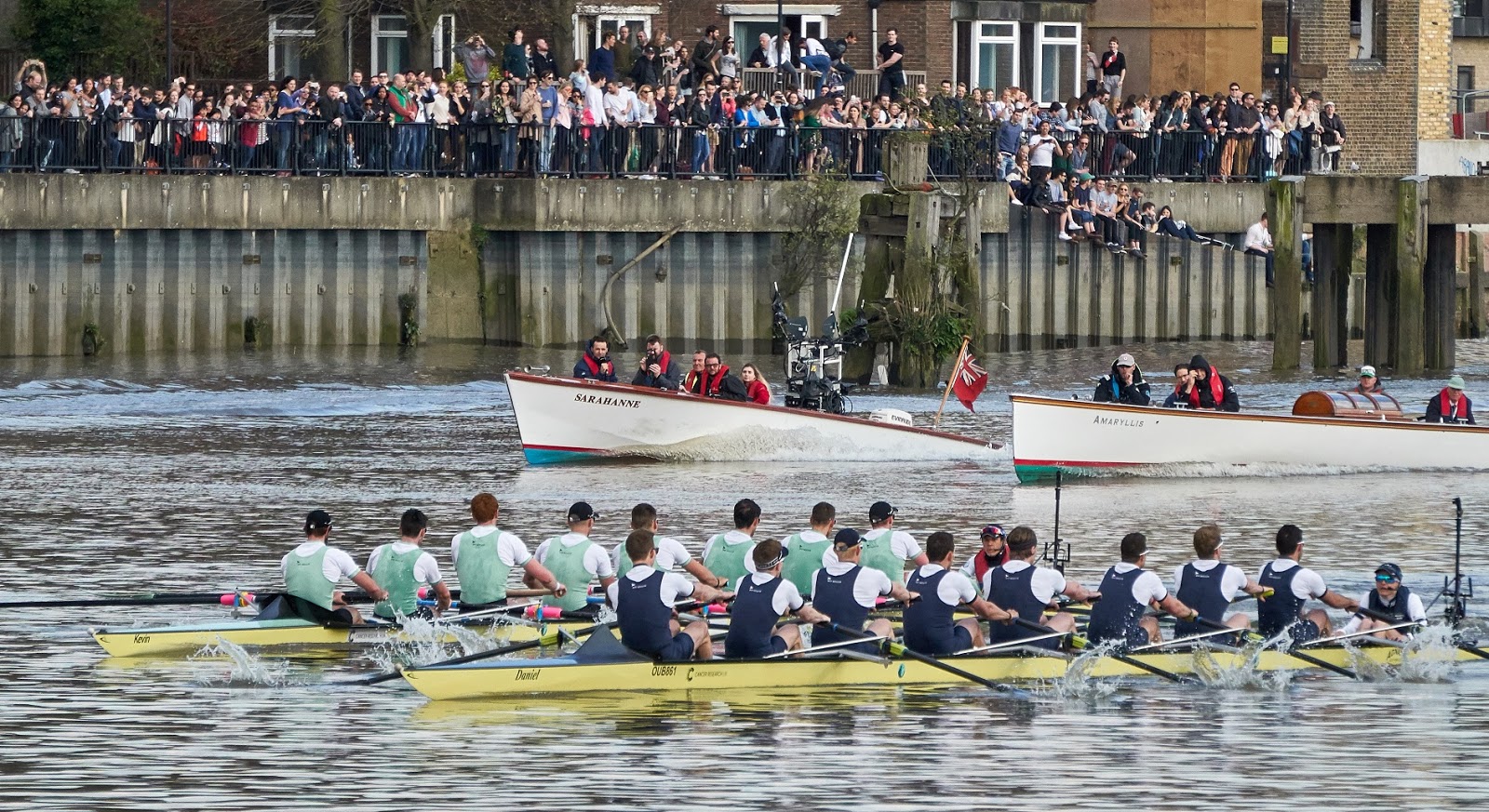
Alas the men's team was a different story:
In the women's race the Cambridge team (above) was so far ahead of Oxford I couldn't get boat boats in frame at the same time. Just brilliant!
Alas the men's team was a different story:
Much closer and the "wrong" team ahead. It wasn't to be Kevin what won it this year.
So like last year a draw, but the other way round.
Saturday, April 01, 2017
Switching to YouTube
Hi Guys!!
OMG! So FINALLY JP is no longer going to be total lame-ville and moving from Blogger to YouTube!
He's SAYS its because of the quality and story telling of SV Delos, but who's he kidding???!!
It was of course yours truly and my vlogging chums who taught him everything he needs to know. You know, me and Millipede are like SO CLOSE!! I mean, that night of the launch party for the Tiny Girls new single!!! We raved until dawn!! Then AGAIN with the lads from Kurupt FM!!
So we put together a series of videos to tell losers like JP (and this Liam fella) how to do it.
AND YOU CAN TOO!!!
Gotta go - streaming live in five!!!
Luv ya!
Sassi
Subscribe to:
Posts (Atom)