Monday, March 03, 2014

A Greenland Yarn: Lost in the Fog

The temperature dropped like a stone and soon I was shivering: I had to get moving, and at first I just ran, hoping to catch the others, but it was useless. All I did was disorientate myself, so that when I finally just stood and looked around I had no idea which way was which or recognise any feature.

I was completely lost, in the fog, in Greenland, in icy conditions, with no compass and totally inadequate clothing. I knew I needed to go south, but without luck or guidance I'd most likely head the wrong way, in a land where there was no human settlements for 200 miles in any direction.

Think! I told myself, sitting down on a rock. Think!

There must be clues nearby. Never again would I leave the ship without a compass but that would be for later. I knew enough of natural navigation to be able to orientate myself from the sun or stars but there could be no sign of either in the white out conditions I found myself in. There was nothing in sight apart from scattered rocks in every direction.

Except there was something else - the odd creeper, shrivelled ground hugging bushes. Not much, hardy types, that couldn't survive without direct sunlight, so it had to grow on south facing slopes. I stood up, transfixed. I could do this!

Scouting around the valley a pattern began to emerge: signs of green on just the one side while the other was bare. I knew now where south lay, and quickly headed off.

At times it wasn't possible to keep a steady southerly course but had to zig-zag around the terrain. In one valley I wasted valuable minutes debating whether to go left or right when straight ahead was barred by a steep cliff. I chose right and was delighted when half an hour later I spotted the waterfall with a rock wedged above it we had passed on the way out. I was back on the right track.

An hour or so later I scrambled down a rocky slope almost tripping over one of Aurora's shore lines. The dinghy was waiting, with the last of the main group about to go back on-board.

"There you are" said the ship’s mate. "You're just in time for tea".


To be continued...

Sunday, March 02, 2014

A Greenland Yarn: The Hike

We and Aurora made our way south, twice anchoring for the night, each time heading ashore for a leg-stretching hike. In D'Aunay Bugt we spent all day climbing over an endless shambles of rocks to reach the foot of a glacier. The uphill climb under clear blue skies was surprisingly warm: we all started off wearing too many layers and enjoyed drinking from streams fed by fresh snow melt.

The third leg took us into Kangerdlugssuaq Fjord. Here we navigated through a maze of bergs up a narrow channel between rocks into a sheltered anchorage, Sulaili Bugt, named after Robin Knox-Johnston's yacht.

Robin and Chris had started their approach by heading up one of the glaciers on the far side of Watkins Fjord, just north of Sulaili Bugt, and we decided to hike over to see it. After the sweltering scrambling at D'Aunay Bugt I'd learnt my lesson and dressed down to t-shirt and shorts, which helped make light work of the hours clambering up and down countless ravines.

The view did indeed make the walk worthwhile and I was loath to leave. "I'm going to head over to that lookout" I said to the ship’s mate, indicating a tempting outcrop. "I'll catch you up".

It was pretty stunning: the channel was chocked in ice, fed by no less than three glaciers. But the scene suddenly vanished as the whole landscape was engulfed by a wave of thick encroaching sea fog.

Visibility dropped from tens of kilometres to tens of meters in just a few seconds, and I realised I had no way of knowing where I was or how to get back to the boat!


To be continued...

Saturday, March 01, 2014

A Greenland Yarn: Palo and the Kunik

Our new friend had dark hair tied into a ball on top of her head. Her smile was wide and friendly and cheeks full and curvy as the rest of her figure. She pointed to her chest and indicated her name was Palo and then pointed around at the party, enquiringly.

By this time some of us were bright red - and not because of the water temperature – and were looking for an excuse to return to the boat. However I decided it was time to do my bit for Anglo-Inuit relationships and told Palo I was called John.

It was then that I learnt about the custom called kunik, which is not like the Eskimo kissing you see in movies but rather more of a pressing the nose against the forehead and breathing in.

Palo started prattling along like there was no tomorrow and to be honest I'd be happy spending some time trying to work out what she was saying.
Unfortunately at this point the others told me that we had to return to the ship for dinner as Siggi had made his famous narwhale steaks stewed in ginger and he wouldn't appreciate late comers.

It was with sense of loss that I made my way back to Aurora. Looking behind me I could see Palo alone lying down in the water surrounded by clouds of steam, apparently lost in thought, watching the icebergs glide by in the fjord below, her bare back white and gleaming.

I still dream of her, sometimes.


To be continued...

Friday, February 28, 2014

A Greenland Yarn: A Polar Bear and Hot Bath

Our first anchorage was behind Turner Island just south of Scoresby Sund, the entrances protected by bars only a few metres below our keel. Here we could stretch our legs, some climbing a nearby peak where they encountered an Arctic hare, while I joined another group hiking towards the next fjord. We were perturbed to notice many bear prints lingering on the volcanic black sand and find seal skulls, possibly their victim.

We rejoined Aurora to cross the fjord and had just stepped onshore from the dinghy when we saw a polar bear a short way along the beach. Quickly we returned to the yacht and spent the next ten minutes watching the bear tuck into a narwhale carcass we guessed had been left behind by some Inuit hunters. It didn't seem comfortable eating with company so it grabbed what looked like a fin and ambled away until out of sight.

Returning to land we spotted more narwhale remains as we hunted for the hot springs reportedly in the area. After searching for about an hour we were rewarded by finding not just one but three, and we split along gender lines, the women soaking themselves in one surrounded by bright green moss while I joined the other men in a pool created by a dam of rocks, served by a volcano like cone which sprouted boiling water.

It was really rather hot and as we dared each other to dunk our heads under water we didn't notice the Inuit hunting party making their way towards us. They spoke no English but their smiles were friendly and warm so we made signs inviting them to join us.

This led to a sharp exchange of words and one starting haranguing the others, indicating they should return to their boat. They seemed to give in and trudge away, while the victor turned to us with a smile.

It was only then that we realised she was a woman, who quickly stripped off and joined us in the pool!


To be continued...

Thursday, February 27, 2014

A Greenland Yarn: The Old Sailor

There seemed no immediate danger as our course would pass the iceberg, just, but we were getting ever closer. As it approached I spotted a shape on its upper slopes.

"Siggi" I called below, but there was no reply.

I peered closer, wiping my glasses clean, struggling to resolve what it was, for the brain was rejecting what the eye could see. On the top surface of the iceberg was a lifeboat, its wooden planks blown grey by countless years of Arctic winds. Who could guess how long it had sat there, what port it had set sail from? But it wasn't alone, for propped up against the stern was a figure, gaunt, bearded, frozen in his sitting position, hands cradling a metal mug: a sailor from another age.

"Siggi" I called again.

Then the iceberg began to rotate, to flip, as underwater its foot had melted so much it became unstable. The lifeboat slipped downwards, as if to be launched, and the old sailor's arm was flung up in one final salute, his mug flying off in an arc to splash in the sea near me. For a moment it looked like they would be free after centuries of being locked to the berg; then its peak came crashing down dragging both under. Boulders of ice broke away, scattering over the sea like crumbs on a table. A wave raced towards us and Aurora rocked, precariously.

"What happened?" asked Siggi, his head finally appearing in the companionway.

I thought of telling him about the boat, about the sailor.

"A berg rotated" I answered, and he returned below, satisfied.

I kept watching, hoping for some wreckage to appear amongst the waves and growlers. Just as I was about to give up I saw the sailor's old metal mug, bobbing gently. It was kept afloat by the air pocketed ice within it which was melting, and suddenly the mug sank below, quickly lost in the dark waters, leaving behind the sailor's last drink as a dark brown tiny iceberg: tea maybe?

I watched it fall astern until out of sight, then felt like a reviving hot cup for myself.


To be continued...

Wednesday, February 26, 2014

A Greenland Yarn: The Iceberg

My voyage to Greenland started in Isafjordur in the north west of Iceland where I joined the Clipper 60 Aurora, which had once been Antiope, Robin Knox-Johnston's expedition yacht. With skipper Siggi and ten others we planned to sail across the Denmark Straight and spend two weeks exploring, kayaking and hiking.

We cast off during one of the long northern summer dusks, pointing Aurora's nose nearly due north as we skirted cliffs, navigated through tidal rips and magnetic anomalies, admired the Lord of the Rings peak of the Hornbjarg and watched playful dolphins dance around the bow.

The chill increased along with our latitude and as we approached Greenland we plunged into banks of mist, from which emerged floating slivers of ice followed by white cathedrals towering above us.

On the second night, Siggi was below while the others were asleep, leaving me alone on deck, keeping watch. We were making way under a light north easterly through mostly calm seas lit from the surrounding clouds. It was peaceful, but unsettling.

I heard it before I saw it. There was the slap of waves against its side and the faint fizzing cracking of ice in a G&T. Suddenly, to starboard, out of the murk appeared a shadowy wall like a chalk cliff.

It was an enormous iceberg, drifting down from the far north.


To be continued...

Tuesday, February 25, 2014

42. The Neptune

Back in October I wrote 41 top tips for Geneva, it being my 41st trip there.

So for obvious reasons here's an update:

42. One boat to look out for is the Neptune, a 27.5m long lateen rigged boat built in 1904. Restored in 2004 she still sails though most of the time you can find her moored on the lakeside between the Jardin Anglais and the Jet d'Eau


Thursday, February 20, 2014

The Marine Quarterly: Winter 2013

Recently I've been recovering from chronic bronchitis and was hunting for something good to read to pass the time.

Luckily one of my Christmas presents was a subscription to The Marine Quarterly, and very readable it proved to be - as you might expect as its editor is Sam Llewelyn, author of cracking sailing thrillers like Dead Reckoning.

There were a baker's dozen articles, all non-fiction (as far as I know) and each a few thousand words so quick to read.

To give an idea of the variety, here are my favourites:
- a description of what its like to winter in the Greenland ice
- 14 things about rowing across the Indian Ocean
- what makes a good sea cook
- an article on Conrad and the sea
- the origin of sea monsters (on old maps that is, not real ones)
- barking dog navigation (or the smell of fish and chips)

So that's half of the articles in this edition that were my favourites - which must be a good sign. There were a couple of others about fishing which to be honest isn't really my thing.

Thumbs up for my subscription so far.


Tuesday, February 18, 2014

Book Review: Joanna Kavenna's The Ice Museum

In the fourth century BC the Greek explorer Pytheas sailed between the pillars of Hercules, modern day Straights of Gibraltar, then headed north to reach Britain.

He sailed further, up to Scotland and then onwards for six days until he reached the land he called Thule. Its inhabitants described how in the summer the sun never set and in winter it was always dark, and nearby the water itself turned solid.

It was his furthest north, and he turned round to make his way back to the warm waters of the Med.

But what did he find? Where was Thule?

The Ice Museum is about the search for Thule across the wide lands of northern Europe, from Iceland to Norway and even the Baltic.

The subject is of course of interest to one who has himself sailed north from Scotland, and Tristan and I encountered both the Faroes and Iceland.

In many ways Iceland does indeed match the description of Thule - the only drawback is there is currently no evidence of it being inhabited that far back.

The book builds on Thule as a historical place to Thule as an idea, and how that changed over time as the far north itself was explored and then mapped. Once it was the furthest unknown, a place of gothic wonders far from civilisation, then contaminated, as it became a symbol of purity for the Nazis, and finally a name to place on a military base in Greenland.

I enjoyed this book though must admit I wanted to have read more about methods to try and place where Pytheas's Thule actually was (as in his Wikipedia entry) and less about the bonkers ideas of the Nazis.

But its well written and readable, a travelogue that uses a word from the far past and furthest north to visit many interesting places and to meet characters ranging from poets to ex-presidents.

Sunday, February 16, 2014

Quiz: which sailor are you?

We've probably all seen those on-line quizzes to find out which (say) Game of Thrones character you are, so how about a what type of sailor you are?

Just answer these five easy questions:

1. Why do you sail?
a. To beat everyone
b. For the experience
c. To reach inaccessible locations
d. To see the world

2. What do you sail?
a. Racing yacht or dinghy
b. Powerboat
c. Classic yacht like a Bristol Pilot
d. Comfortable yacht

3. Who do you sail with?
a. Depends upon the class rules
b. Prefer alone
c. With some mates
d. With your family
e. With your dog

4. You are:
a. Male
b. Female

5. Your age is:
a. Under 20
b. 20 - 35
c. 36 - 50
d. Over 50

Answer is the closest match to one of the following:
- Ben Ainslie: 1a, 2a, 3a
- Ellen MacArthur: 1b, 2a, 3b
- Jeremy Clarkson: 1b, 2b, 3c
- H. W. Tilman: 1c, 2c, 3c
- Liza Copeland: 1d, 2d, 3d
- Tristan Jones: 1d, 2c, 3e

Note that questions 4 and 5 are only there so we can target the adverts better and hence increase our revenue (thanks for that).

Friday, February 14, 2014

The beauty of maths

Recently Tillerman posted some equations, which I found rather intriguing, even though they seemed only to be how to calculate the force on a Laser sailor's bum.

However its fair to say that not everyone likes maths. To many its abstraction and symbols are a barrier, or a memory of painful days at school, for whom it's hard to believe that equations can be beautiful.

But they really can and to prove it scientists put mathematicians in a brain scanner as they looked at gems like Euler's identity:
This is just stunning, so much of what is important in maths connected together in just a few symbols.

And the reaction on those mathematicians brains, as you can read in this BBC news article, was that the neurons that were fired included those that are triggered for great works of art or music.

There really is beauty in equations.

Of course I've been lucky enough to study maths up to university level, so I've had quite a bit of training.

However the equation at the top (as tweeted by @CERN) is hopefully one that all can appreciate, how ever much maths they've done, as it defines the following 3D shape:


Thursday, February 13, 2014

Extreme Warning: Ebb Tide

Recently the weather in blighty has gone from our favourite topic of conversation to something really quite serious, with force 12 in Fastnet and the Thames valley flooded.

The Thames Barrier has been raised every day for the last fortnight to allow as much water as possible to drain out of the upper Thames without flooding central London.

All well and good but that means that when the high fluvial levels (posh term for flow) combine with the tidal ebb the current is really rather strong - four times normal according to the Evening Standard. In fact dangerously strong.

The Port of London Authority (PLA) has therefore introduced a new web-based ebb tide safety flag indicator system and it's currently saying "Extreme Warning".

You can find the flag on the PLA's web site for recreational river users, boating on the Thames. There's even a widget you could stick on your own site.

To help explain why this really is serious look at the image above, which is a rowing eight stuck against a barge. As can be read here:

Their rowing eight was driven under boat moorings and  broken in half by the strength of the tide.

Canoers, kayakers and sailors should also take note.

As an extra warning, have a read of this article about what is contaminating the water - yuck!

Extreme warning indeed.

Wednesday, February 12, 2014

Fastnet Force 12

According to the Met Office's shipping forecast there are gale warnings pretty much everywhere including the following for Fastnet:

Southwesterly violent storm force 11 increasing hurricane force 12 imminent

Despite what it says on the t-shirt, at the moment I'd rather not be sailing, and not just because of my lingering cough.

Tuesday, February 11, 2014

From the Thames Barrier to the Thames Floods


Video from Channel 4 News.

That's a lot of water.


Updated: there's also a very similar video from BBC news which has sub-titles. Tillerman: note you can see the area around Marlow clearly

Watch those Cumec flow

More on Thames flow and flooding.

The post yesterday showed how the Thames Barrier is being raised to allow as much water as possible to flow down river to ease the floods in the Thames valley.

The figure above shows the Thames flow at Teddington, which is where the river goes from non-tidal to tidal, taken again from this great web site.

The yellow lines show the mean and the {10, 50, 70 ,95) % of time exceeded flow rates, with the 10% of time exceeded flow rate 161 cumecs, a lovely little word that is short for cubic metres per second.

For the last couple of days the actual rate has been pretty constant at 300 cumecs, almost twice the level which is only exceeded for 10% of time. It's so constant that it looks like its being controlled, limited to that rate.

However you have to look at the video of the Thames valley to get a sense of the scale of the flooding: this not just worse than its been in years but decades if not centuries. It will take some time for these waters to subside.

One big debate is on which locations should be protected against floods with the usual complaints about London getting the resources.

However we only have to look at the damage that Sandy did to New York to see the extreme cost of letting down your guard.

Take the underground network as described in this article: consider how London would grind to a halt without its tube and how many billions that would cost. Other measures are possible - such as floodgates within the network itself - but these are no longer functioning because of the Thames Barrier.

The Thames Barrier might have cost a lot but it means that central London assumes that it will be taken care of and hence would actually be vulnerable to flooding without the constant protection of the barrier.

However expensive the flooding is in the Thames valley it would be dwarfed by the cost should central London flood.

Though maybe we should all be thinking more carefully about the cost of global warming.

Monday, February 10, 2014

Dam the Thames to relieve the flood

The answer to yesterday's Thames River Flow Puzzle is that the unusual behaviour was due to the Thames Barrier being raised.

As blogged earlier, there's been enough rain in the last few weeks to give modern day Noahs incentive to finally get building that big boat project, and the Thames valley has gone beyond soggy.

Indeed if you type "River Thames" into the Environment Agencies web site you find there are currently 76 warnings including 14 which are "Severe", meaning there is danger to life.

The map above comes from the BBC web site and shows the most at risk locations.

There is one clear direction the water can flow that would ease the flood risk - down river. But uncontrolled increased river flows could combine with a high tide to drown central London, causing catastrophic damage.

So the Thames Barrier has been raised, to stop the incoming tide and allow as much water as possible to drain out of the Thames valley.

This can be seen in the image below from this brilliant web site (as blogged earlier) grabbed last night:

You can see the levels towards Teddington significantly above predicted as increased flows are released with the barrier closed to hold back the tide.

This is unlike the expected requirement for the Thames Barrier, which was to protect the capital from storm surges coming up the estuary, as happened at Canvey Island in 1953.

So you can indeed relieve a flood by damming a river - by using the Thames Barrier.

But it still looks pretty bad - good luck to all those in the at risk locations.


Sunday, February 09, 2014

River Thames Flow Puzzle

The Thames in central London doesn't flow like rivers inland. Under steady state conditions, most inland rivers behave like this:

Inland River:
- flow: down river
- level: constant

The Thames in central London is tidal so it has basically two behaviours with slack water in between:

Ebb:
- flow: down river
- level: falling

Flood:
- flow: up river
- level: rising

Recently I've seen the Thames go from Ebb to Inland River to this:

Unusual behaviour:
- flow: down river, slowing to a near stop
- level: rising

What phenomena is causing this unusual behaviour of the Thames?


Updated: the answer is that the Thames Barrier has been raised, damming the river and causing the water level to increase while the flow continues, though the flow rate slows as the Thames in central London fills up, effectively becoming a long thin lake.

Update 2: as an indicator of how close to a near stop the flow becomes after the barrier has been up for some time, moored boats become aligned with the wind direction rather than river flow. There also seems to be all sorts of minor eddies and secondary flow effects which are quite hard to tie down.

Saturday, February 08, 2014

Vote for Natural Navigation

Time for a shameless plug for a friend's blog.

Tristan aka the Natural Navigator's blog is up for the Go Outdoors 2014 blog award and you can vote by heading over to this web page.

To give you a taste of what gems of navigation you can discover, check out this description of how cranes can be wind indicators, as suggested by, er, someone... another blogger maybe ..... look, it's not important who!


Friday, February 07, 2014

Flooded Eel Pie

Back in December I headed upriver to visit the wonderfully named Eel Pie Island, one of the few inhabited islands on the Thames in London.

As well as having a superb location blending green fields with sparkling water it has a stellar history of art and music. In the now closed Eel Pie Hotel you could hear the likes of The Rolling Stones, David Bowie, The Who, Pink Floyd and even Ivor Cutlor.

Since then it has become an artist colony - and also a centre of boat building and repair. At the galleries open day I could admire canvases dotted around proper sized sheds equipped to build and repair ocean going yachts:
It has no roads, just the footbridge (top) connecting it to mainland, and is a quiet oasis where a lucky few live with views like this:
I was pretty envious to be honest - particularly for the mooring rights.

However it sounds like things are not going, er, swimmingly at the moment. As anyone living in blighty right now will know all too well it has been very very wet start to 2014, and Eel Pie Island's position makes it rather vulnerable to rising river levels.

According to the Evening Standard a "police task force had to rescue stranded members of the public from Eel Pie Island".

The water level in Putney sometimes does indeed flood the Embankment but it is controlled. The water level here is directly connected to its height at Westminster and you can guarantee that that location will be the highest priority for those managing the Thames.

Indeed to protect central London the Thames Barrier has been working over-time, rising a record 13 consecutive tides to block the incoming tide which otherwise would combine with river flows to burst banks which should never be breached.

But even that doesn't seem to have been enough to protect Eel Pie Island.

And tomorrow another storm is forecast to blow in.

Better get those wellies ready.


Tuesday, February 04, 2014

Book Review: James Evans's Merchant Adventurers

(Cough) (Cough)

Ok, enough of being sick, time to review a good book to read in these dark months (north of the equator).

I really enjoyed James Evans's Merchant Adventurers. As well as being a well written story of exploration in the age of sail it also describes one of the pivotal moments in English history that laid the foundation for what would become the British Empire.

In the mid 16th Century Spain and Portugal were building colonies around the world and England wanted in. It employed Sebastian Cabot (son of the more famous John) to recruit and train sailors and captains with the skills needed for deep ocean sailing and navigation.

Their mission: to find a short cut to the riches of Cathay and the far east by heading north, what would be called one day the north-east passage.

It's not giving the game away much by saying they failed, but in connecting to the Russia of Ivan the Terrible they discovered something better - trade.

The title "Merchant Adventurers" sums up much about this voyage. It was financed by nobility but also merchants, and to ensure an equitable framework a new concept was brought to London: the "joint stock company". It would revolutionise business practice laying a foundation on which much later the industrial revolution could build.

Led by Sir Hugh Willoughby and the highly able Richard Chancellor, the working practices of the expedition were also different from those of (say) the Spanish and Portuguese fleets. They didn't sail to conquer but to trade, believing that both parties can gain that way, and they also employed empirical methods, with strict instructions to record all they observe so that future missions could learn in what we'd now call a scientific method.

Strongly recommended for anyone interested in the history of sail and the early European voyages of exploration.

Sunday, February 02, 2014

Join Bart's Bash on 21st September 2014


I've spent the last three weeks coughing & battling chronic bronchitis but its worth breaking the blogging break for this, the announcement of Bart's Bash.

As you can read here, the aim is to have the world's largest sailing event on 21st September 2014 to honour the memory of Bart Simpson.

Lets go sailing

Sunday, January 12, 2014

London Boat Show 2014: the rest

Captions please! I have absolutely no idea what is going on here between the RYA's mascot and the Royal Marines.

Currently I've got a cough like a sea lion with double pneumonia so simply posting a few photos from last weekend's trip to the boat show.

This sub looks particularly James Bond worthy:
This is the boat show as seen through the window of a gin palace:
Finally Buff Staysail was in good form reminiscing about a Boat Show a few years ago when he arranged to meet three different women at three different bars:
But of course who can believe that.

Thursday, January 09, 2014

London Boat Show 2014: the boats

You can't have a boat show without boats - I'm pretty sure about that. And even though the London Boat Show seems to be shrinking year by year there are still plenty of good boats to check out.

For starts, out on what once were the London Docks was a couple of classic boats. Above is the fire boat the Massey Shaw all powered up and there was no takers in its water fight challenge. The Massey Shaw was build in 1935 and saw service in WW2 at both Dunkirk and also the blitz in London, most likely around these very docks.
Further down the quay was the motor tug Kent:
There was also a Challenge 72 and the Thames barge Melissa (I so want to sail a Thames barge);
Inside was one of those cross-oceans rowing boats, here the Coxless Crew:
Sounds much too much like hard work for me but good luck to all four rowers

If I had a magic wish to go on any boat at the show then my choice would be this Extreme 40:
To quote Jeremy Clarkson "MORE POWER!!"

And it appears I'm not the only one as none other than Sir Ben Ainslie is including sailing Extreme 40s in his busy schedule.


Tuesday, January 07, 2014

London Boat Show 2014: the people

The London Boat Show continues to shrink, with ever fewer stands. But still I go as I keep finding reasons to be there.

First up there were the people met, such as Tom Cunliffe (above) giving a talk at the World Cruising Club stand on how you can sail away for less than you might think. We had a very brief chat about Greenland which we both had recently sailed to.

Immediately after him was Will Stirling (below) talking about the expedition to row to the magnetic north pole (among other things). At a previous boat show I met the expedition leader Jock Wishart. Will is currently aiming to sail around the offshore lighthouses of Britain in a dinghy.
Then there was Sam Llewellyn, writer of many a good sailing novel and editor of the Marine Quarterly, a subscription to which I received at Christmas.

And finally there was the chance to catch up with Stokey Woodall who I met last year and who gave a talk on celestial navigation including the star clock. I told him I'd worked out why the answer was 41.5 and promised to email him its derivation (which I did).

Those four chats were an excellent start - but what about the boats....?

Monday, January 06, 2014

London's top four outdoor ice rinks

So after four years study here are four of London's top outdoor ice rinks for those winter months.

1. Somerset House (above). The original and the best. Lovely size and location, often sold out for a good reason.

2. Hampton Court (below). Another great location and less crowded, plus you can visit Henry VIII's palace or go on the river (except when its flooded)
3. Tower of London (below). This is where I had that horrid prang which sort of put me off it but its an unbeatable location though of course a bit touristy:
4. The Natural History Museum (below). Bit small but handy for those in SW London and there are dinosaurs next door and as we know everything is better with a dinosaur:
Any favourite rinks out there that I've missed?

Sunday, January 05, 2014

Twelfth Night at London's Bankside

Wassail!!

Yea, verily it be twelfth night, and old London Town has been visited by the GREEN MAN!

He arrived by boat, the Thames Cutter, Trinity Tide (above), which was rowed by honourable men of great strength for the tide did flow most powerfully.

The ancient and legendary GREEN MAN brings fertility, a promise that SPRING will come again.

And he was welcomed by much crowds and the good and the great of SOUTHWARK:
But some were much afeared, as there were the forces of darkness to be overcome, for BEELZEBUB himself was to be cast out:
Stirred to great words were all present and "Wassail" did cry out not once, not twice, not thrice, but uncountable times, in praise of the RIVER and the GLOBE:

The Globe Wassail

Blowe wind, Globe bear well
Spring well in playing
Every lath and timber
Bear the tongues of poets
Next New Year's summer!

Wassail!

And then with great cheer the good folk of London Town went their separate ways, some by foot and some by the mighty River Thames:

The Boat Wassail

Blowe wind boat bear well
Ride well on the tide
Every beam and every sail
Bear the crew bravely home
Each sailing day!

Wassail!!


More from the Lions part here.

Saturday, January 04, 2014

Ice Skating at Hampton Court

London is spoilt for choice when it comes to Christmas ice rinks, many at spectacular locations, and over the last few years I've been trying them out.

I only go once or at most twice a year and each year there's a lot of wobbling before even more wobbling and hesitant steps. Ice skating isn't really my thing.

But back in 2012 when skating at the Tower I had this bad fall and damaged the ligaments around my lung, which I really don't recommend, and I was determined not to let it put me off.

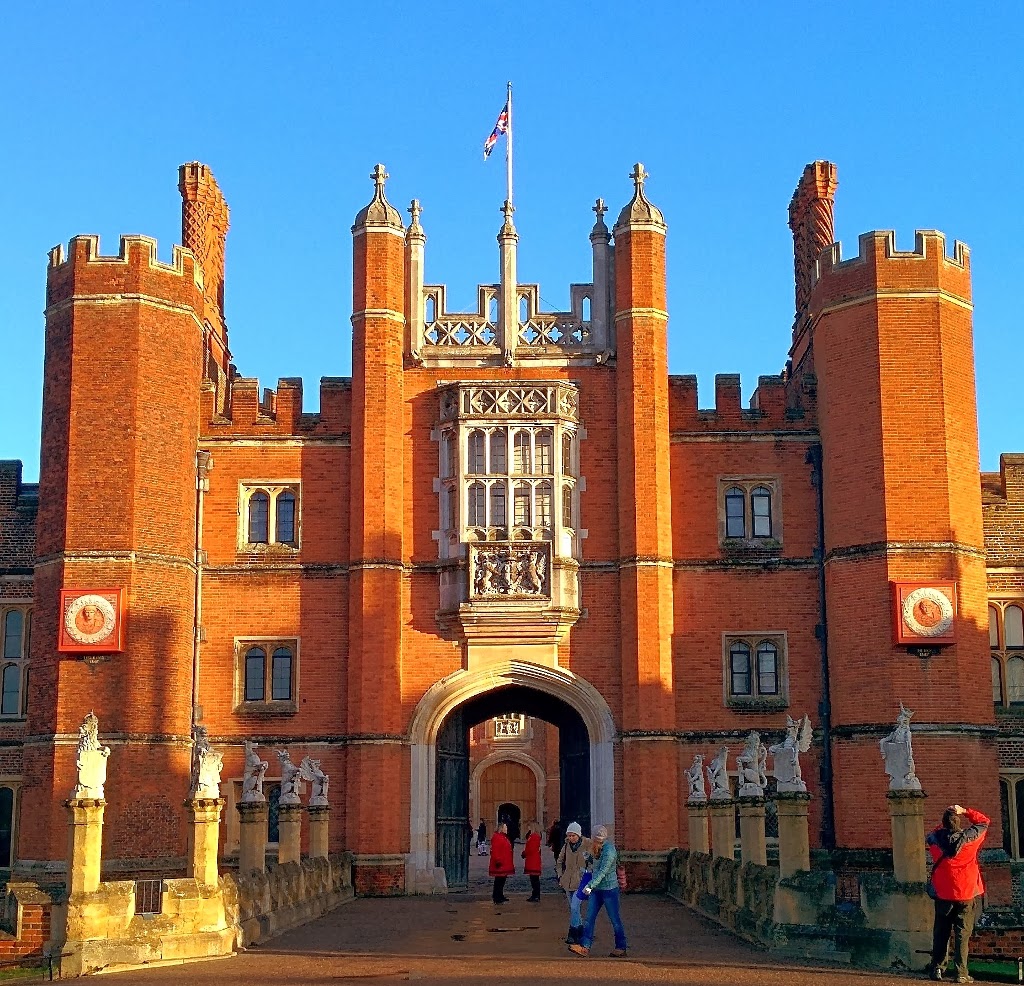
So I went down to the highly impressive Hampton Court which was Henry VIII's pad and you could see why he'd want to invite his many girlfriends back to it:
It's on the non-tidal part of the Thames in London and the recent storms meant the river was high and rushing, flooding the banks:
Even though these three photos show a clear sky it did actually rain during the skating session, but only for a short time.

But I didn't mind that: any skate you don't end up in A&E I'd call a good one.


Friday, January 03, 2014

What makes a good year?

It's the time of the review's of 2013 and usually blogging is no exception - except this year we seem to be lacking posts on that subject.

There is a certain degree of the "what I did with my summer holidays" assignment that might people off, but there can be positives.

Sometimes its just the pleasure of going through a year, remembering the good times and places visited.

Sometimes there is real case for celebration, such as the amazing summer of 2012.

But there are also benefits: to spot trends and to help answer that key question for the New Year: what makes a good year?

I think that 2013 was a good year for me because of the travel. Lots of interesting places visited including Vienna, Australia, China, Iceland, Greenland (above) and Geneva.

There was also a lot of good books read during 2013, from the voyages of Mingming, Vikings, Robin Knox-Johnston and Tristan Jones all about sailing to Greenland and the north.

Another theme during the year was photography, with lessons from Rick Tomlinson and a reviews of three cameras.

Of course there was Buff, Sassi and their adventures in show-biz and the America's Cup.

The plans for 2014 are still foggy, but if last year is a guide I should try to include some good travel, sailing to interesting places, good books and a spot of fiction writing too.

What do you think?

Wednesday, January 01, 2014

Thought for the New Year

While catching up on the back-log of 2013 photos I realised I hadn't properly organised the stack of pics from Helsinki back in June 2012.

I must have been distracted by a certain major event soon after.

Anyhow I found this image as thought for the New Year.

More humbling than uplifting - and if its the latter you want head over to Windtraveller here.